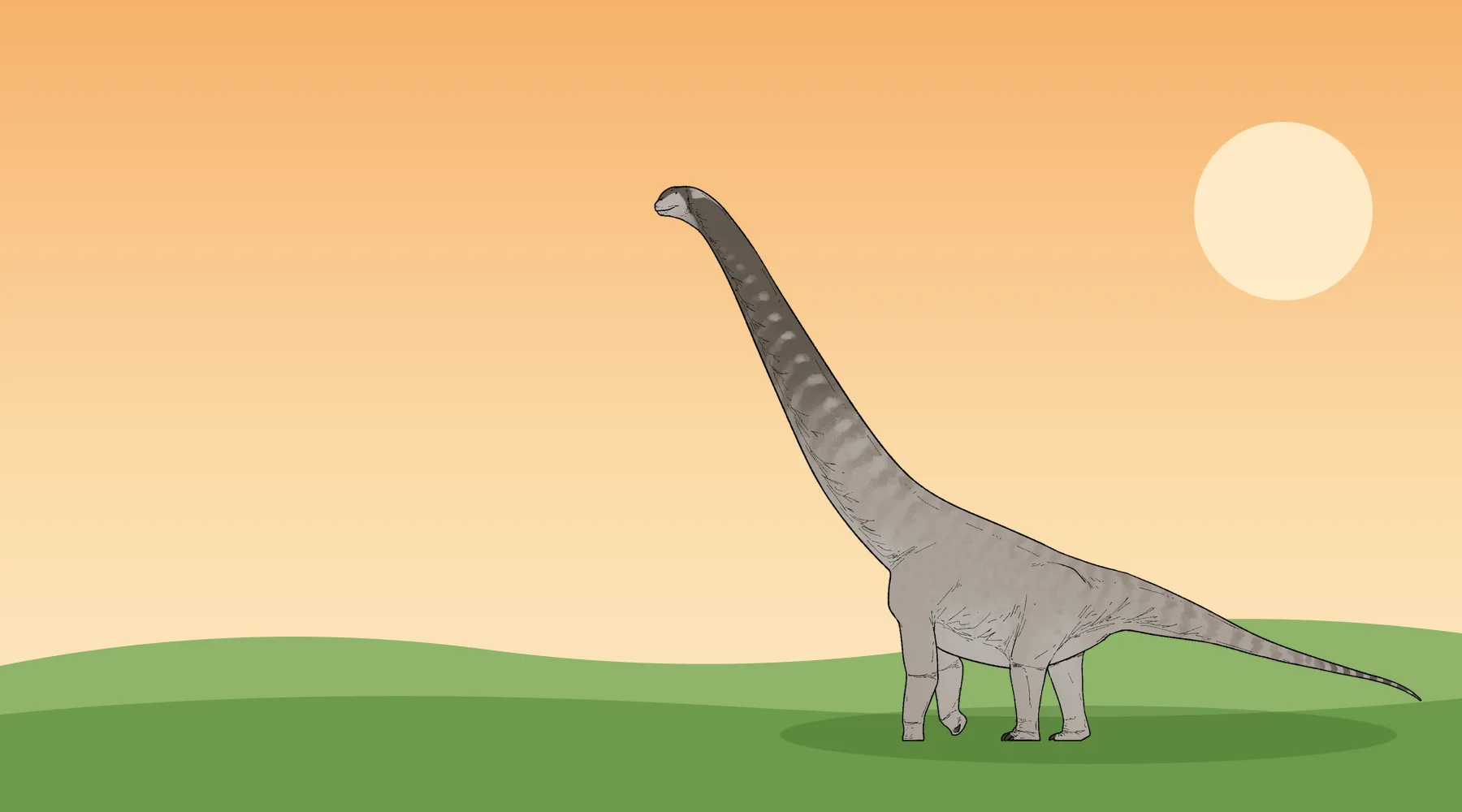
Bones by a village pond, a promise made by a dinosaur-loving kid, and ten years of digging. This is the true story of Nagatitan, the biggest dinosaur ever found in Southeast Asia.
✅
Quick Answer
The new dinosaur is Nagatitan chaiyaphumensis, a giant long-necked plant-eater named on May 14, 2026. It all started in 2016, when a villager in Chaiyaphum, Thailand, spotted strange rocks by a drying village pond. They turned out to be the bones of the biggest dinosaur ever found in Southeast Asia.
How Nagatitan Was Found, Step by Step
Finding a new dinosaur isn't a quick treasure hunt. Nagatitan took ten years from the first bone to its brand new name. Here's how it happened.
🦕
Long, long ago
A giant falls by a river
About 113 million years ago, a huge long-necked dinosaur died near a river in what is now northeastern Thailand. Mud and sand slowly buried its bones, and they turned to stone.
☀️
Dry season, 2016
A pond shrinks and a secret appears
In the village of Ban Pha Nang Sua in Chaiyaphum province, the hot dry season made the village pond shrink. As the water went down, strange stony shapes poked out of the muddy bank.
👀
2016
A villager speaks up
A local villager, Thanom Luangnan, noticed the odd rocks and did exactly the right thing: told the authorities instead of digging them out. Experts came to look, and the rocks were giant dinosaur bones!
⛏️
2016 to 2019
The big dig
Scientists from Thailand's Department of Mineral Resources and Mahasarakham University dug carefully around the pond. They found backbones, ribs, hip bones and enormous leg bones, all from one animal.
🧽
The following years
Cleaning and scanning
The bones went to the Sirindhorn Museum in Kalasin, where experts slowly cleaned off the rock. The bones were 3D scanned so scientists in London could study them on a computer and even 3D-print copies.
✅
2024
The last bones come out
Digging up the rest of the skeleton finished in 2024. Now the team could compare every bone with other giant dinosaurs from around the world.
🎉
May 14, 2026
A brand-new dinosaur!
The team announced in the science journal Scientific Reports that the bones belong to a species nobody had ever seen before. They named it Nagatitan chaiyaphumensis.
Meet the People Behind the Discovery
It took a whole team, from a villager to museum workers to scientists on the other side of the world, to bring Nagatitan back to life on paper.
🧑🌾
Thanom Luangnan
The villager who spotted the bones
Every great dinosaur story starts with someone noticing something. Without a sharp-eyed neighbor walking by the pond, Nagatitan might still be hidden in the mud.
🧒
Thitiwoot “Perth” Sethapanichsakul
Lead scientist, a Thai PhD student at University College London
Perth says they were always a “dinosaur kid” and promised as a child to one day name a dinosaur from Thailand. Nagatitan made that childhood wish come true!
🌏
Dr. Sita Manitkoon
Dig leader, Mahasarakham University and National Geographic Explorer
Dr. Manitkoon led the fieldwork in Chaiyaphum and says Thailand has far more dinosaurs waiting to be found than most people realize.
🖥️
Professor Paul Upchurch
Long-neck dinosaur expert at University College London
Instead of flying the heavy bones to London, the team shared 3D scans. Professor Upchurch pointed out that this also helps the planet by cutting down on travel.
🧪
The museum team
Sirindhorn Museum, Kalasin
Fossil preparers spent many hours chipping and brushing away rock, piece by piece, so the bones could be measured and studied.
💜 A dream come true: Perth grew up loving dinosaurs and promised to one day name one from Thailand. If you love dinosaurs too, maybe the next new species will be yours!
What Bones Did They Find?
Scientists didn't find a whole skeleton. That's normal! Most dinosaurs are known from just some of their bones. For Nagatitan, they found:
🦴Backbones · from the back and hips
🫁Ribs · from its giant barrel chest
🦵Thigh bone · a mostly complete femur
💪Upper arm bone · 1.78 m (5 ft 10 in) long!
🪨Hip bones · parts of the pelvis
By measuring how thick the arm and leg bones are, scientists worked out how heavy the animal was. Thick bones were needed to hold up a huge body.
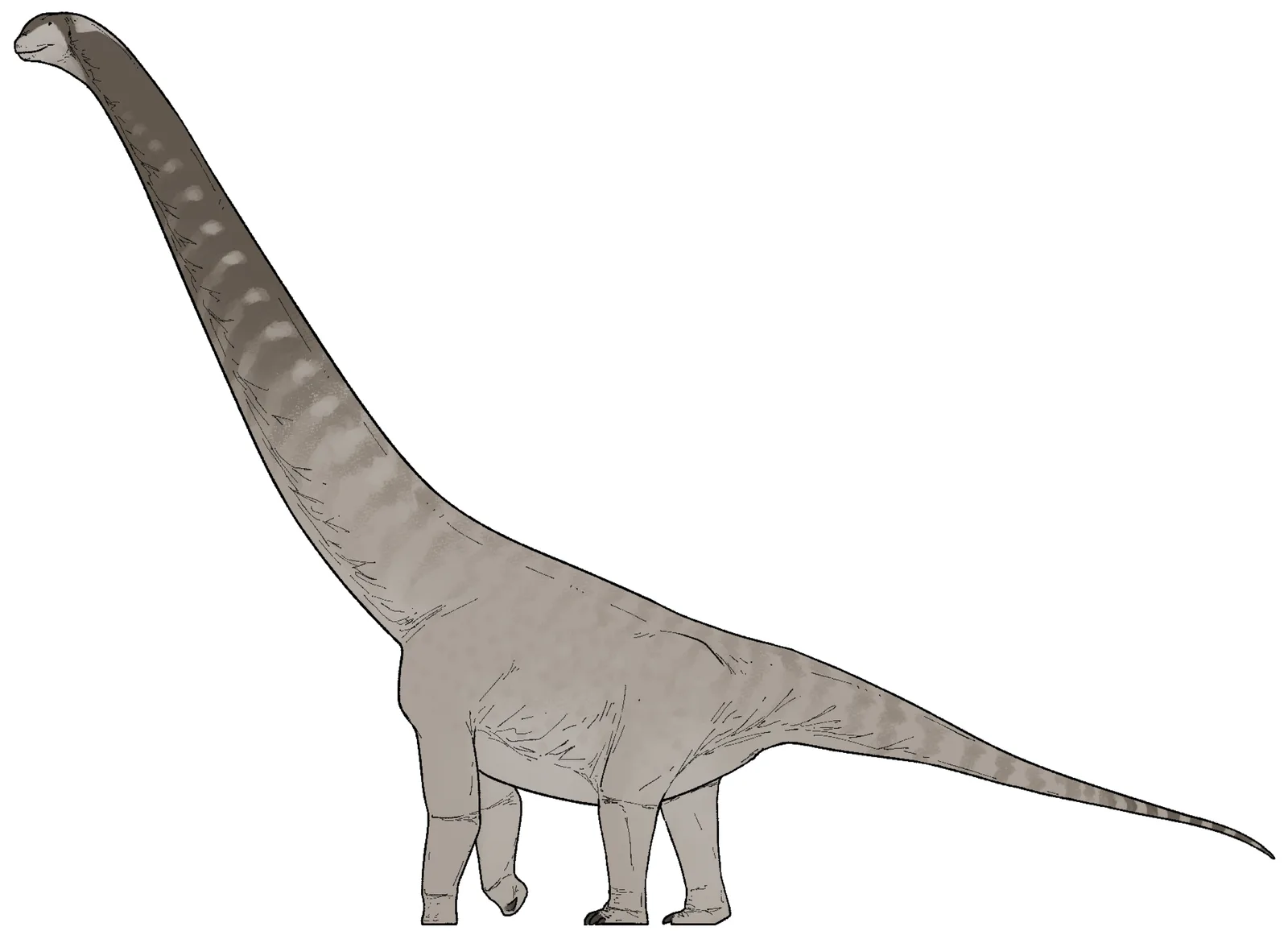
What Nagatitan may have looked like. Artwork by Connor Ashbridge.
How Did Nagatitan Get Its Name?
The person who describes a new species gets to name it. Perth chose a name with a little bit of Thai legend in it.
Naga 🐉
A giant magical serpent from Thai and Southeast Asian legends. You can spot naga statues guarding the stairs of many Thai temples. Its long body is a lot like a long dinosaur neck!
titan 🏛️
The giants of ancient Greek stories. Scientists often add “titan” to the names of the biggest long-necked dinosaurs.
chaiyaphumensis 📍
Means “from Chaiyaphum,” the province in northeastern Thailand where the bones were found.
Say it like this: NAH-gah-TIE-tan chai-yah-poom-EN-sis.
How Big Was the Last Titan?
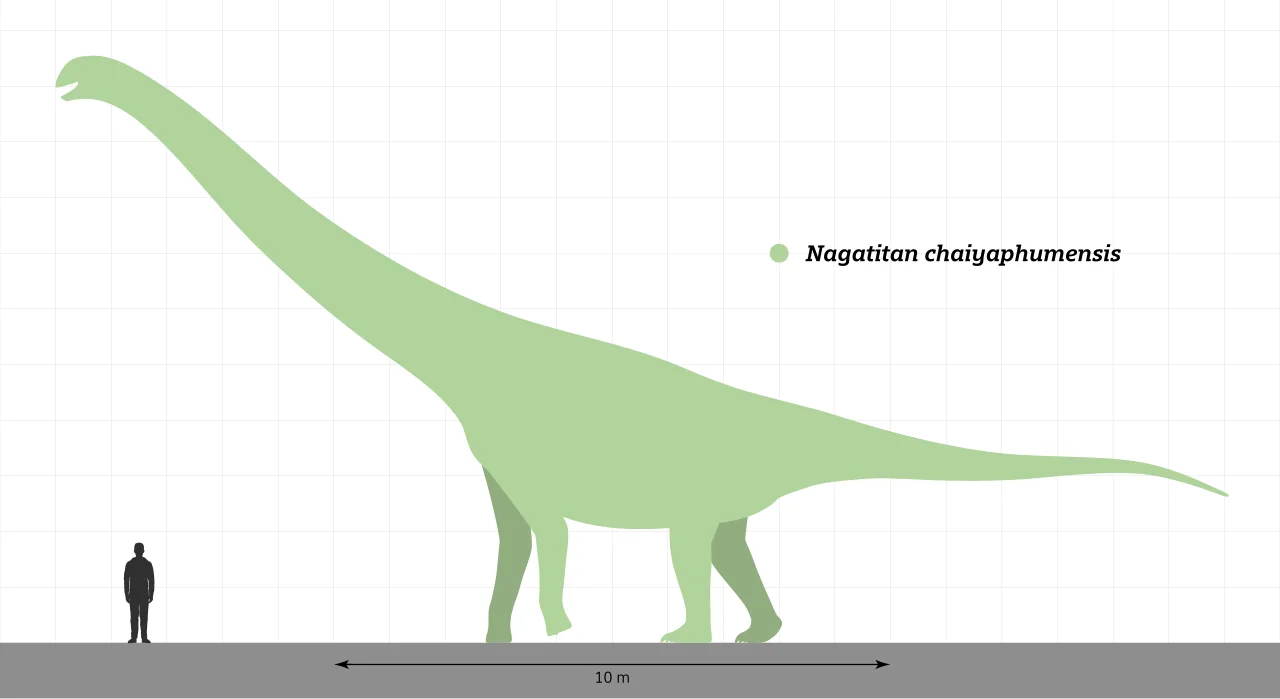
Nagatitan was about 27 meters (89 feet) long, about the length of two school buses parked end to end. It weighed around 27 tonnes, as much as nine adult Asian elephants!
Scientists nicknamed it the last titan because its bones come from the youngest layer of dinosaur rock in Thailand. It was one of the last giant long-necks there before the land changed.
It was the biggest dinosaur in Southeast Asia, but not the biggest in the world. South American giants like Patagotitan were even heavier. Meet more giants in our long neck dinosaurs guide.
Nagatitan compared with a grown-up person. Chart by SlvrHwk.
What Was Thailand Like When Nagatitan Lived?
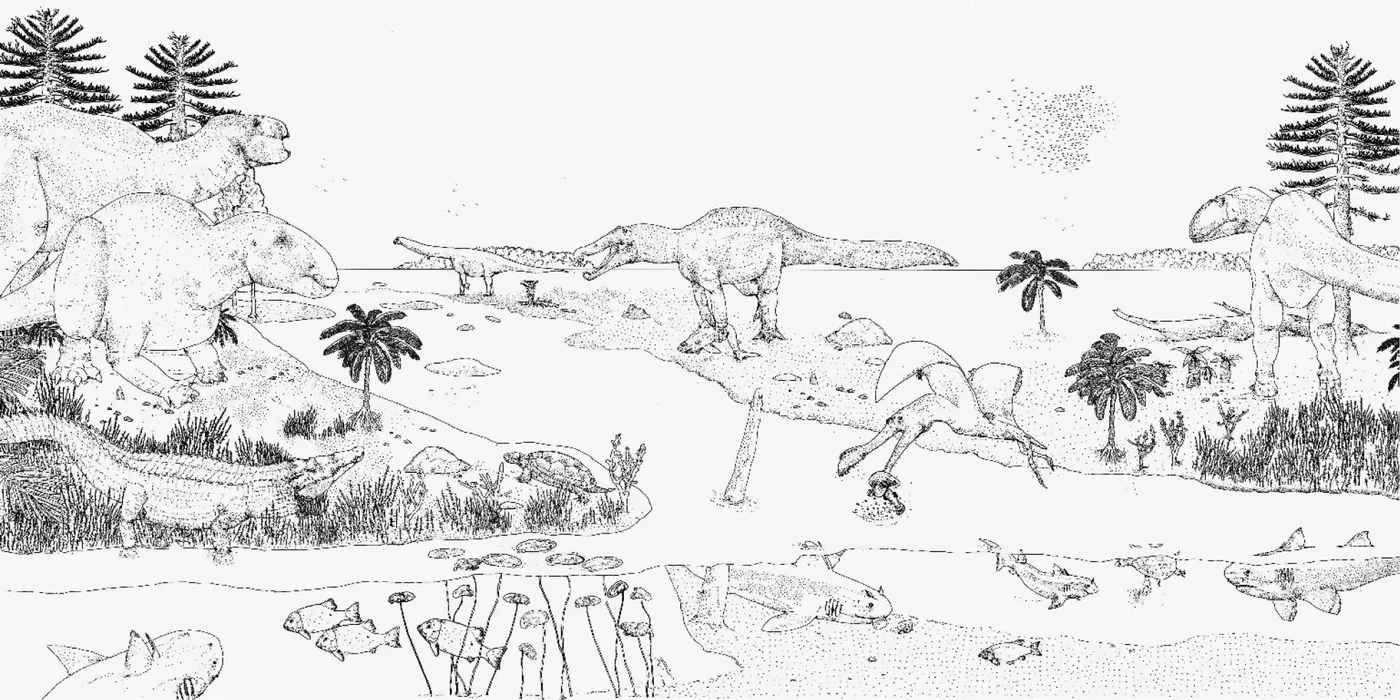
A scientist's drawing of this ancient Thai riverbank, about 113 million years ago. Drawing by Sakka Weerataweemat. Fun idea: print it out and color it in!
About 100 to 120 million years ago, in the Early Cretaceous, this part of Thailand was warm and fairly dry, with winding rivers. Scientists think Nagatitan's long neck and tail may have helped it let off heat, a bit like an elephant flapping its big ears.
Nagatitan had lots of neighbors. Fossils from the same rocks include Siamraptor, a big meat-eater; small plant-eaters like Psittacosaurus; crocodiles, turtles, fish and even freshwater sharks in the rivers; and pterosaurs swooping overhead to catch fish.
Thailand's Other Dinosaur Discovery Stories
Nagatitan isn't the first surprise from Thailand's rocks. Many Thai dinosaurs were found by accident, by people who were looking for something else entirely.
1976
While hunting for uranium at Phu Wiang in Khon Kaen, geologist Sudham Yaemniyom spotted a bone in a stream bed. It was the end of a giant leg bone, and the first dinosaur fossil ever found in Thailand.
1986
Thailand's first dinosaur gets a name: Siamosaurus, a fish-eating predator known from its teeth.
1994
Phuwiangosaurus sirindhornae, a long-neck from Phu Wiang, is named in honor of Princess Sirindhorn. It turned out to be the owner of that very first 1976 bone!
2016
A villager spots bones by a pond in Chaiyaphum, starting the Nagatitan story.
2026
Nagatitan is named as Thailand's 14th dinosaur species. A few months later, scientists name another long-neck, Uragasaurus, from a single backbone found in Kalasin.
🤯 Fun fact: Thailand's first dinosaur bone was found by a geologist looking for uranium, not dinosaurs. Lots of big discoveries happen by accident!
What Should You Do If You Find a Fossil?
The villager in Thailand is a great example to follow. If you ever find something that looks like an old bone in a rock:
📸
Take a photo
Snap a picture with something for size, like a shoe or a coin, and note exactly where you found it.
✋
Don't dig it out
Pulling a fossil out can break it and lose important clues about the rock around it.
📞
Tell an expert
Contact a local museum, university or geology office, just like the villager in Thailand did.
Grown-ups: in many places, fossils on public or protected land belong to everyone and can't legally be collected, so reporting them is always the best plan.
Where Can You See Thai Dinosaurs?
🏛️ Sirindhorn Museum Kalasin: where the real Nagatitan bones are kept and cleaned
🏛️ Phu Wiang Dinosaur Museum Khon Kaen: near the spot where Thailand's first dinosaur bone was found
🏛️ Thainosaur Asiatique, Bangkok: has shown a life-size Nagatitan model
Can't get to Thailand? See where kids can visit real dinosaur bones around the world in Are Dinosaurs Real?
Frequently Asked Questions
What new dinosaur was found in Thailand?+
Nagatitan chaiyaphumensis, a giant long-necked plant-eating dinosaur (a sauropod). It was announced on May 14, 2026 and is the largest dinosaur ever found in Southeast Asia.
Who discovered Nagatitan?+
A local villager, Thanom Luangnan, first spotted the bones in 2016 on the bank of a village pond in Chaiyaphum province. Scientists from Thailand and University College London then dug up and studied the bones. The study was led by Thai scientist Thitiwoot Sethapanichsakul.
Why did it take 10 years to name a dinosaur found in 2016?+
Fossils take a long time to dig up, clean and study. The bones were excavated from 2016 to 2024, cleaned at the Sirindhorn Museum, 3D scanned, and compared with other giant dinosaurs from around the world before scientists could be sure it was a new species.
What does the name Nagatitan mean?+
“Naga” is a giant mythical serpent from Thai and Southeast Asian legends, and “titan” means giant. The second part, chaiyaphumensis, means “from Chaiyaphum,” the province where it was found.
How big was Nagatitan?+
About 27 meters (89 feet) long and around 27 tonnes, about as heavy as nine adult Asian elephants. One of its upper arm bones is 1.78 meters (5 ft 10 in) long, taller than most grown-ups.
Why is Nagatitan called the “last titan”?+
Its bones come from the Khok Kruat Formation, the youngest layer of dinosaur rock in Thailand. That makes Nagatitan one of the last giant long-necks known to have lived there.
Where can I see Nagatitan?+
The real fossils are kept at the Sirindhorn Museum in Kalasin, Thailand. A life-size model has been on display at the Thainosaur museum at Asiatique in Bangkok.
Sources: Sethapanichsakul et al., Scientific Reports (May 14, 2026); University College London; Thailand's Department of Mineral Resources and Government Public Relations Department.
Image credits, via Wikimedia Commons under CC BY 4.0: Nagatitan life restoration by Connor Ashbridge (background added by Puffsaurus for the top image); Nagatitan size comparison by SlvrHwk; Khok Pha Suam environment drawing by Sakka Weerataweemat (from Manitkoon et al.).
Does your little one love dinosaurs? 🦕
Explore our dinosaur-themed nursery rhymes and kids' songs!