
How Big Was the Asteroid That Killed the Dinosaurs?
It was bigger than a mountain, faster than a bullet, and left a hole bigger than a whole city. Let's see just how big it really was!
Quick Answer
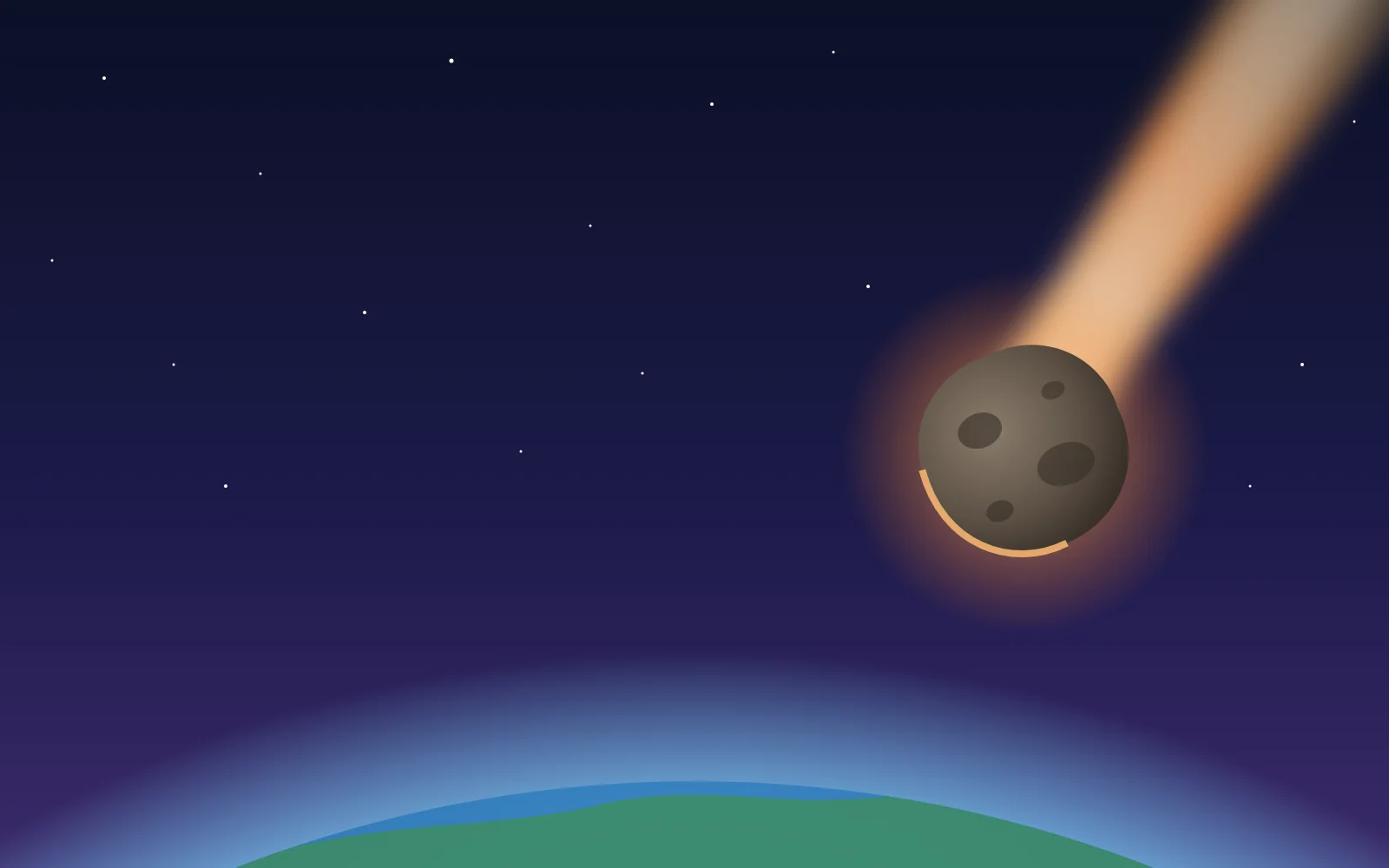
The asteroid that killed the dinosaurs was about 6 miles (10 km) wide, taller than Mount Everest. It hit Earth about 66 million years ago near Mexico at around 45,000 miles per hour and blasted out a crater about 110 miles (180 km) wide.
The Dinosaur Asteroid by the Numbers
6 miles
wide (about 10 km)
45,000 mph
speed (about 20 km every second)
110 miles
wide crater (about 180 km)
Trillions
of tons of rock
Scientists worked out its size from how much asteroid dust ended up in rocks around the world and from the size of its crater. Most say about 6 miles (10 km), though some estimates go up to about 9 miles (15 km).
Was It Bigger Than Mount Everest?
Yes! Mount Everest, the tallest mountain on Earth, is about 5.5 miles (8.8 km) tall. The asteroid was about 6 miles (10 km) across. If you could set it down next to Everest, it would stand taller than the mountain, and its top would almost reach where jet planes fly.
How Big Is 6 Miles, Really?
About 100 soccer fields
Line up about 100 soccer fields end to end, and that's how wide the asteroid was.
12 of the world's tallest buildings
Stack 12 Burj Khalifas (the tallest building on Earth) on top of each other to reach across it.
A 2-hour walk
A grown-up would need about 2 hours to walk from one side of the asteroid to the other.
As high as a jet flies
When the bottom of the asteroid touched the ground, the top was still about as high as airplanes fly.
How Big Was It Compared to Earth?
Here's the surprising part: compared to Earth, the asteroid was tiny. Earth is about 1,300 times wider.
🏀 If Earth were a basketball, the asteroid would be about the size of a grain of fine sand.
So how could something so small cause so much trouble? Its speed. The asteroid was moving about 12 miles (20 km) every second, around 20 times faster than a bullet. At that speed you could fly from New York to Los Angeles in about 3 minutes. Hitting something that fast releases an enormous amount of energy, millions of times more than the biggest explosion people have ever made.
How Big Is the Crater It Left?
When the asteroid hit near Mexico's Yucatán Peninsula, it blasted out a giant crater called Chicxulub (CHEEK-shoo-loob). It is about 110 miles (180 km) wide, roughly 18 times wider than the asteroid. It would take about 2 hours to drive across it on a highway!
Scientists also worked out that the asteroid came in at a steep angle, about 60 degrees, which threw even more rock and dust into the sky. To find out what happened next, read when and how the dinosaurs went extinct.
What Was the Asteroid Made Of?
In 2024, scientists studied tiny bits of the asteroid that are still trapped in rocks today. They found it was a carbonaceous asteroid: a dark, crumbly space rock full of carbon and clay, a bit like a giant lump of charcoal and mud.
Rocks like that formed far out in the solar system, beyond the planet Jupiter. That means the dinosaur asteroid probably traveled a very long way before it reached Earth. It also makes it very unlikely that it was a comet.
How Does It Compare to Other Asteroids?
Dimorphos · 0.1 miles (160 m)
The little asteroid NASA's DART spacecraft bumped off course in 2022.
Apophis · 0.2 miles (340 m)
Will zoom safely past Earth in April 2029, so close that people in some places may see it without a telescope.
Bennu · 0.3 miles (490 m)
NASA's OSIRIS-REx spacecraft scooped up a sample and brought it to Earth in 2023.
Dinosaur asteroid · 6 miles (10 km)
About 20 times wider than Bennu. Big ones like this hit Earth only about once every 100 million years.
Vredefort asteroid · 12–15 miles (20–25 km)
Hit South Africa about 2 billion years ago, long before dinosaurs. The biggest known impact on Earth.
Could a Giant Asteroid Hit Earth Again?
Don't worry! Asteroids as big as the dinosaur asteroid hit Earth only about once every 100 million years. Scientists at NASA and around the world keep watch on the big asteroids near Earth, and none of them are heading our way.
In 2022, NASA's DART spacecraft even crashed into a small asteroid on purpose and changed its path. It showed that one day, if we ever needed to, we could nudge a dangerous asteroid out of the way. The dinosaurs didn't have a space program, but we do!
Frequently Asked Questions
How big was the asteroid that killed the dinosaurs?
Scientists think it was about 6 miles (10 km) wide, though some estimates go up to about 9 miles (15 km). That's wider than Mount Everest is tall.
Was the asteroid bigger than Mount Everest?
Yes. Mount Everest is about 5.5 miles (8.8 km) tall, and the asteroid was about 6 miles (10 km) across. If you set it down next to Everest, it would stand taller than the mountain.
How big was the asteroid compared to Earth?
Tiny! Earth is about 1,300 times wider. If Earth were a basketball, the asteroid would be about the size of a grain of fine sand. It caused so much damage because it was moving incredibly fast.
How fast was the asteroid going?
About 12 miles (20 km) every second, or roughly 45,000 miles per hour. That's about 20 times faster than a bullet. At that speed, you could cross the United States in about 3 minutes.
How big is the crater the asteroid made?
The Chicxulub (CHEEK-shoo-loob) crater in Mexico is about 110 miles (180 km) wide, roughly 18 times wider than the asteroid itself. Today it's buried under rock and the sea, so you can't see it from the ground.
Where did the asteroid hit?
It hit near the Yucatán Peninsula in Mexico, partly on land and partly in shallow sea. It came in at a steep angle, about 60 degrees, which made it extra destructive.
What was the asteroid made of?
A 2024 study found it was a carbonaceous (car-buh-NAY-shus) asteroid: a dark, crumbly rock rich in carbon and clay. Rocks like that formed far out in the solar system, beyond Jupiter.
Was it the biggest asteroid ever to hit Earth?
No. The asteroid that made the Vredefort crater in South Africa about 2 billion years ago was even bigger, around 12 to 15 miles (20–25 km) wide. But the dinosaur asteroid is the most famous because of what it did to life on Earth.
Did the asteroid have a name?
Not really. Scientists call it the Chicxulub impactor, named after the crater it made, which is named after a small town in Mexico.
Could an asteroid that big hit Earth again?
It's extremely unlikely any time soon. Asteroids that big hit only about once every 100 million years, and NASA keeps watch on the big asteroids near Earth. None of them are on a path to hit us.
All illustrations on this page were drawn by Puffsaurus.
Does your little one love dinosaurs? 🦕
Explore our dinosaur-themed nursery rhymes and kids' songs!