
Pterodactyl Facts for Kids: Is a Pterodactyl a Dinosaur?
Meet the famous “winged finger” that flew over the heads of dinosaurs. Find out what it really was, how big it was, what it ate and how it flew.
Quick Answer
No, a pterodactyl was not a dinosaur. It was a pterosaur (TEH-roh-sore), a flying reptile. Pterosaurs were close cousins of dinosaurs and lived at the very same time, so it's an easy mix-up. Lots of grown-ups call them “flying dinosaurs” too!
Pterodactyl Quick Facts
- Say it
- TEH-roh-DAK-til
- Name means
- “Winged finger”
- What it was
- A pterosaur (flying reptile)
- Wingspan
- About 3.5 ft (1 m), some smaller
- When it lived
- About 150 million years ago (Late Jurassic)
- Where
- Europe (Germany)
- Food
- Small fish, insects and little animals
- First named
- 1809, the first pterosaur ever named
Is a Pterodactyl a Dinosaur?
Pterodactyls look like they belong with the dinosaurs, and they did live alongside them. But scientists put them in a different group called pterosaurs, which means “winged lizards.”
Think of a big family. Dinosaurs and pterosaurs were like cousins: they shared great-great-grandparents long ago, but each grew up on their own branch. Dinosaurs walked on land with their legs straight under their bodies. Pterosaurs grew wings and took to the sky.
So which dinosaurs could really fly? Birds! Birds are living dinosaurs. Find out how we know in Are Birds Dinosaurs?
Pterodactyl or Pterodactylus?
“Pterodactyl” (TEH-roh-DAK-til) is a nickname people use for all flying reptiles, big or small. But there was one real animal with this name: Pterodactylus (TEH-roh-DAK-tih-lus).
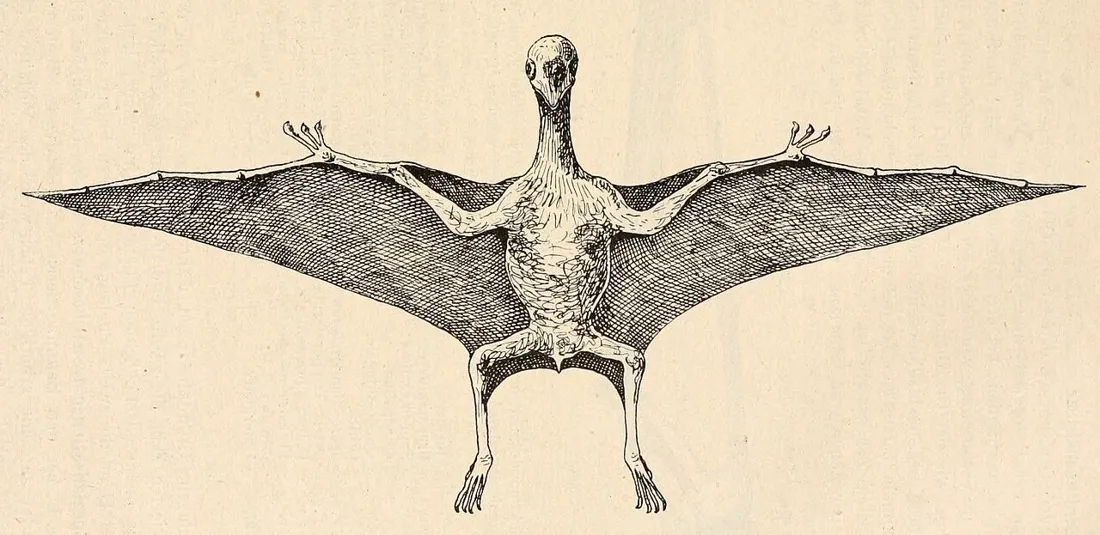
The real Pterodactylus was small, with wings about 3.5 feet (1 meter) from tip to tip, about as wide as a seagull's. It lived about 150 million years ago, in the Late Jurassic, around warm lagoons in what is now Germany.
It was the first pterosaur ever named. A fossil was described by Cosimo Collini in 1784, and in 1809 Georges Cuvier figured out it was a flying reptile and named it.
How Did a Pterodactyl Fly?
A super-long finger
Each wing was a thin sheet of skin stretched from a very long fourth finger all the way down to the legs. Its other three fingers had little claws for climbing and grabbing.
Hollow, light bones
Its bones were hollow and filled with air, so its body was light enough to lift off the ground and flap into the sky.
Fuzzy, not scaly
Pterosaurs were covered in soft, hair-like fuzz called pycnofibers (PIK-noh-fy-bers). It probably helped keep them warm, a bit like a fluffy coat.
🖐️ Try it! Spread your fingers wide. Now imagine your ring finger growing longer than your whole arm, with a sheet of skin running from its tip down to your ankle. That's a pterodactyl wing!
What Did a Pterodactyl Eat?
Pterodactylus was a meat-eater. It had a long, narrow beak lined with lots of small, pointy teeth, perfect for grabbing slippery things.
- Small fish from shallow water
- Insects and creepy-crawlies
- Little animals like shrimp and worms
Scientists think it may have waded along the edges of lagoons, poking its beak into the water and mud to find a snack.
Pterodactyl vs Pteranodon
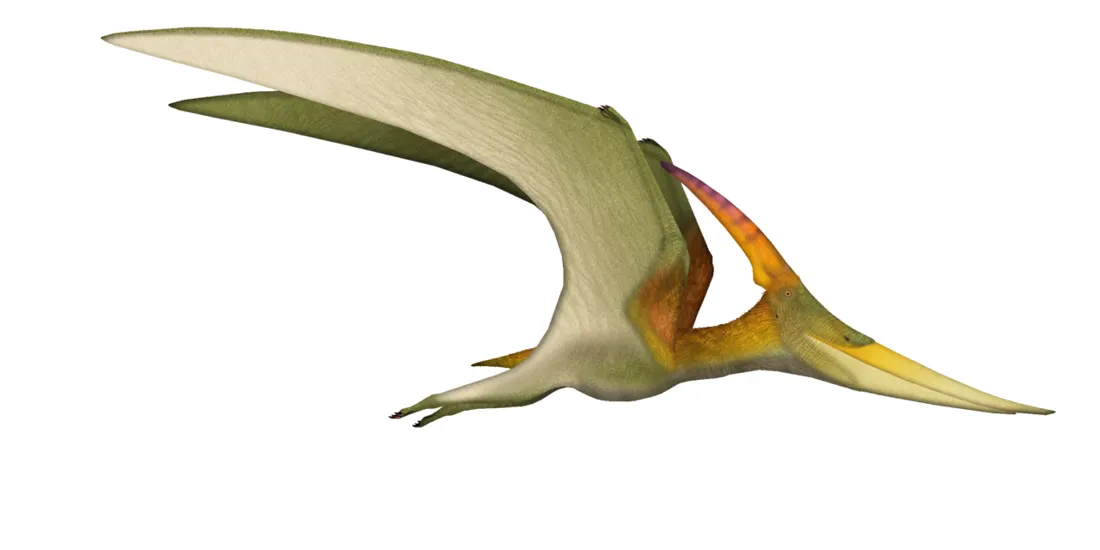
These two names sound almost the same, and both were pterosaurs, but they were very different animals that lived about 65 million years apart!
| Pterodactylus | Pteranodon | |
|---|---|---|
| What it was | Pterosaur (not a dinosaur) | Pterosaur (not a dinosaur) |
| When it lived | About 150 million years ago (Late Jurassic) | About 86–84 million years ago (Late Cretaceous) |
| Where | Europe (Germany) | North America (Kansas) |
| Wingspan | About 3.5 ft (1 m) | Up to about 20–23 ft (6–7 m) |
| Teeth | Yes, lots of small, pointy teeth | No teeth at all |
| Head crest | No big crest | Big, long crest pointing backward |
| Favorite food | Small fish, insects, little animals | Fish from the sea |
Meet a Giant Cousin: Quetzalcoatlus
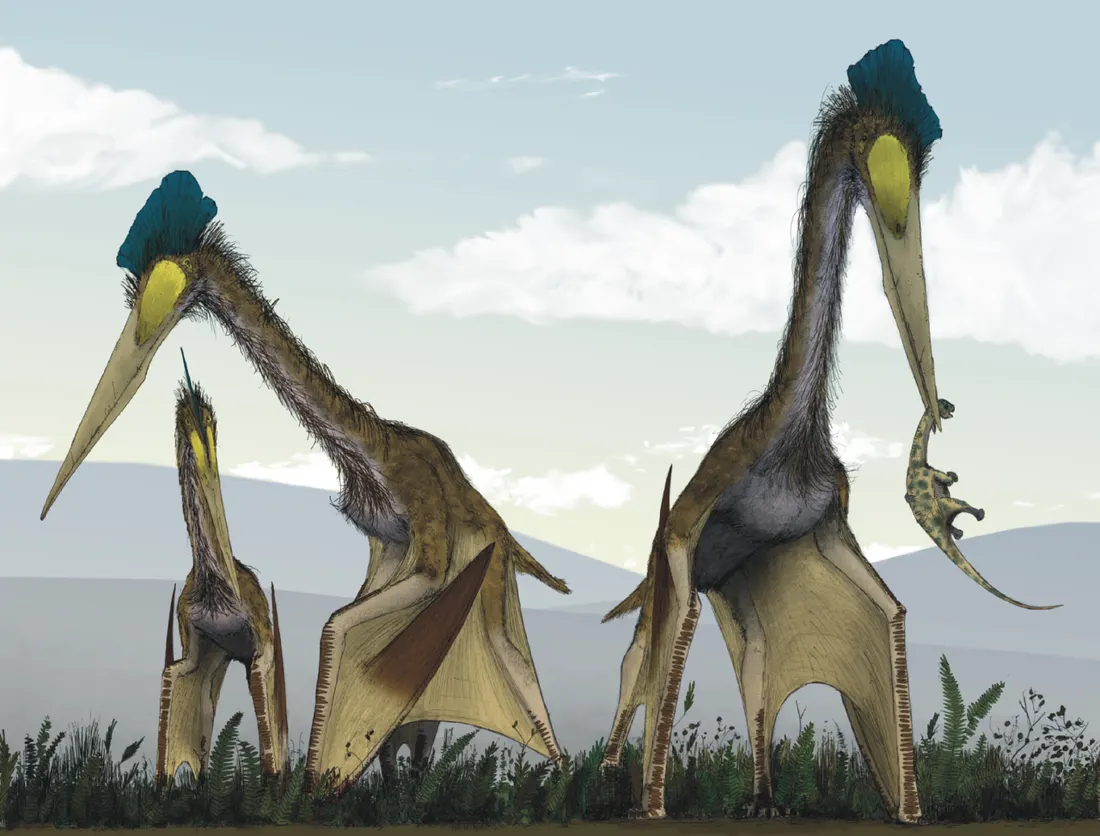
Not all pterosaurs were small like Pterodactylus. Quetzalcoatlus (KET-sal-koh-AT-lus) was one of the biggest flying animals ever!
Its wings stretched about 33 to 36 feet (10 to 11 meters), as wide as a small airplane. Standing on the ground, it was about as tall as a giraffe. Meet more prehistoric flyers on our flying dinosaurs page.
Fun Pterodactyl Facts
- Pterodactylus was the very first pterosaur ever found. An Italian scientist named Cosimo Collini described the fossil in 1784, but he thought it might be a sea animal!
- In 1809, French scientist Georges Cuvier worked out it was a flying reptile and gave it its name, which means “winged finger.”
- Its fossils come from fine, flat limestone rocks in Solnhofen, Germany, the same rocks where the feathered Archaeopteryx was found.
- Some Pterodactylus fossils are so well kept that you can still see the outline of the wing skin!
- Baby pterosaurs could probably fly very soon after hatching, without much help from their parents.
- Pterosaurs were the first animals with backbones to fly, millions of years before birds or bats.
- On the ground, pterosaurs walked on all fours, folding their big wing fingers up out of the way.
When Did Pterodactyls Die Out?
Pterodactylus itself lived about 150 million years ago. Its pterosaur relatives kept flying for millions of years after that. The very last pterosaurs died out 66 million years ago, at the same time as the dinosaurs, when a giant asteroid hit Earth. Read the whole story in When Did Dinosaurs Go Extinct?
👪 A note for parents
If your child calls a pterodactyl a dinosaur, that's a great starting point, not a mistake to correct sharply. Try asking, “Did you know it was actually a dinosaur's cousin?” Comparing family branches (cousins vs. brothers and sisters) is an easy way for young kids to understand how scientists group animals. Older kids may enjoy the Pterodactylus vs. Pteranodon table as a spot-the-difference game.
Frequently Asked Questions
Is a pterodactyl a dinosaur?
No, but it's a very common mix-up! A pterodactyl was a pterosaur, a flying reptile. Pterosaurs were close cousins of dinosaurs and lived at the same time, but they were on their own branch of the reptile family tree.
Could pterodactyls really fly?
Yes! Pterodactyls flapped their wings and flew, just like birds and bats do. Their wings were made of skin stretched from a super-long fourth finger, and their light, hollow bones made flying easier.
How big was a pterodactyl?
The real Pterodactylus was small. Its wingspan was about 3.5 feet (1 meter), about as wide as a seagull's or a crow's wings spread out, and some were even smaller. Other pterosaurs, like Quetzalcoatlus, were giants with wings 33 feet (10 meters) wide.
What did pterodactyls eat?
Pterodactylus ate small fish, insects and other little animals. It used its long, narrow beak and small, pointy teeth to snap up its food, maybe while wading at the edge of shallow lagoons.
Are pterodactyls extinct? When did they die out?
Yes, pterodactyls are extinct. Pterodactylus itself lived about 150 million years ago. The last pterosaurs died out 66 million years ago, at the same time as the dinosaurs, when a giant asteroid hit Earth.
Did pterodactyls lay eggs?
Yes! Scientists have found fossil pterosaur eggs, some with tiny babies still inside. The eggs had soft, leathery shells, a bit like many lizard and turtle eggs today.
What is the difference between a pterodactyl and a Pteranodon?
Both were pterosaurs, but Pterodactylus was small, had teeth and lived about 150 million years ago in Europe. Pteranodon was much bigger, had no teeth, had a big crest on its head, and lived about 85 million years ago in North America.
Image credits (via Wikimedia Commons): Pterodactylus by Othenio Abel, 1919 (public domain); Pteranodon by TotalDino (CC BY 4.0); Quetzalcoatlus by Mark Witton and Darren Naish (CC BY 3.0).
Does your little one love dinosaurs? 🦕
Explore our dinosaur-themed nursery rhymes and kids' songs!