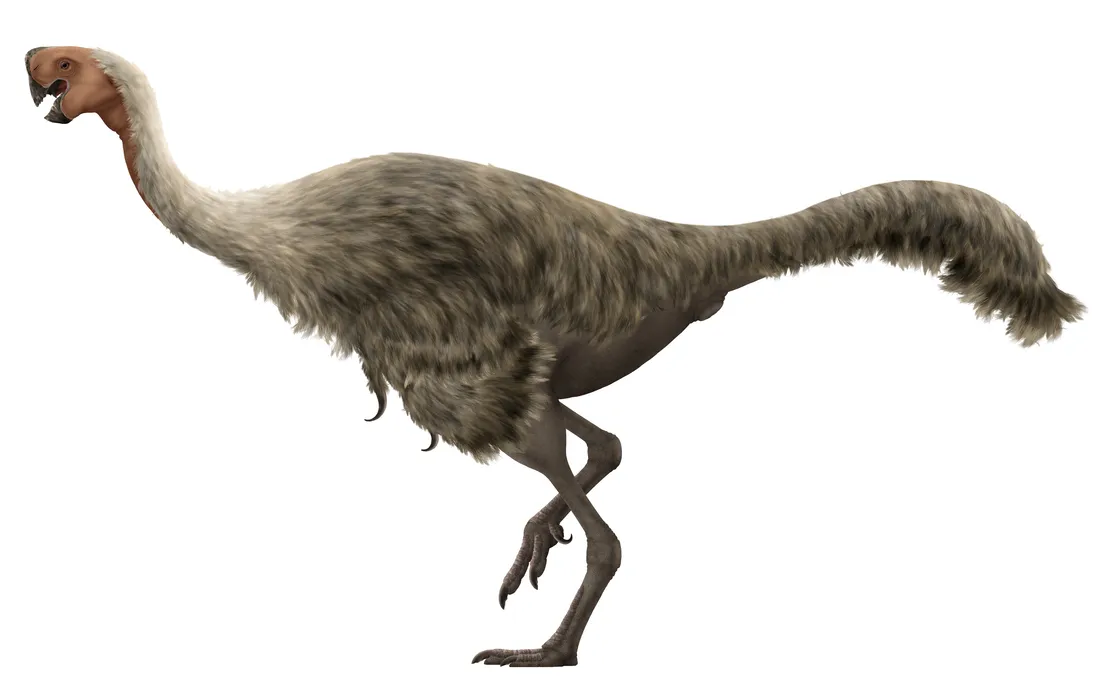
PuffsaurusPuffsaurus
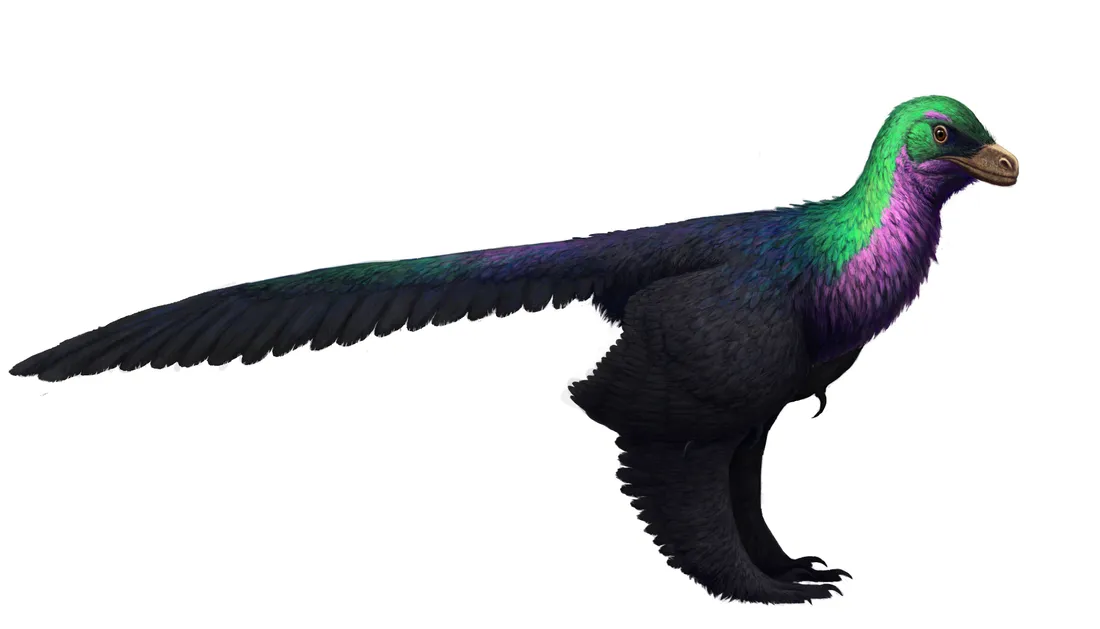
Caihong, a small feathered dinosaur with shiny black wings and a rainbow-colored neck
Types of Dinosaurs

Feathered Dinosaurs

Fluffy, fuzzy, rainbow-colored and fancy: meet the dinosaurs with feathers, and find out why so many dinosaurs looked more like big birds than lizards.

Quick Answer

Yes, lots of dinosaurs had feathers! Scientists have found dozens of kinds of feathered dinosaurs, from fluffy Yutyrannus, a 30-foot cousin of T. rex, to tiny rainbow-colored Caihong. Most couldn't fly. They used feathers to stay warm, show off and protect their eggs. Some feathered dinosaurs did learn to fly, and they became today's birds.

What Are Feathered Dinosaurs?

Feathered dinosaurs are dinosaurs whose fossils show feathers, fuzz or bristles on their bodies. Most of them belong to the theropods, the two-legged, mostly meat-eating group that includes T. rex, Velociraptor, and the ancestors of birds.

Not every dinosaur feather looked like a bird's feather. Some were simple fuzz, and others were stiff bristles or long ribbons. Here are the five main kinds, from simplest to fanciest:

  1. 1

    Fuzz

    Thin, hair-like strands, like the fluff on a baby chick.

    Seen on: Yutyrannus, Sinosauropteryx

  2. 2

    Bristles

    Long, stiff spikes, a bit like the bristles on a brush.

    Seen on: Psittacosaurus, Beipiaosaurus, Yi qi

  3. 3

    Tufts

    Many soft strands joined at the bottom, like a feather duster.

    Seen on: Kulindadromeus

  4. 4

    Vaned feathers

    A center stick with flat sides, like a bird's tail feather.

    Seen on: Caudipteryx, Citipati

  5. 5

    Flight feathers

    Lopsided feathers shaped to push against the air for flying.

    Seen on: Microraptor, Archaeopteryx

10 Feathered Dinosaurs in 5 Groups

Jump to a group: 🧸 Fluffy Fuzzballs Β· 🌿 Surprise! Feathered Plant-Eaters Β· 🦚 Fancy Show-Offs Β· πŸͺΊ Feathered Raptors and Parents Β· πŸͺ‚ Strange Gliders

Fluffy Fuzzballs

The simplest feathers looked like fuzzy hair. Even some big meat-eaters were covered in a fluffy coat.

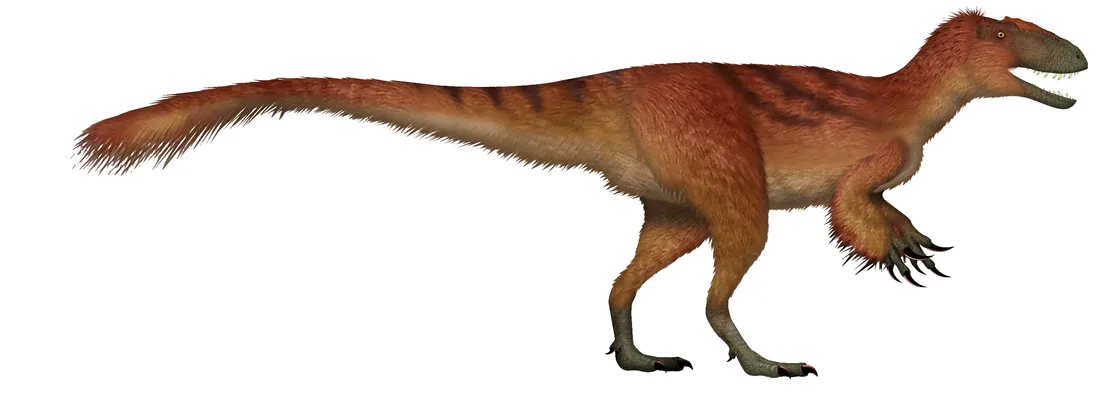
Illustration of Yutyrannus, a large tyrannosaur covered in reddish-orange fuzzy feathers

1. Yutyrannus

Say it: YOO-tie-RAN-us Β· Means: β€œBeautiful feathered tyrant”

Size
About 30 ft (9 m) long
When
About 125 million years ago
Where
Asia (China)

πŸͺΆ Feathers: Long, fuzzy strands up to 8 in (20 cm)

⭐ The biggest dinosaur ever found with feathers, and a cousin of T. rex! It lived somewhere chilly, so its fluffy coat probably kept it warm.

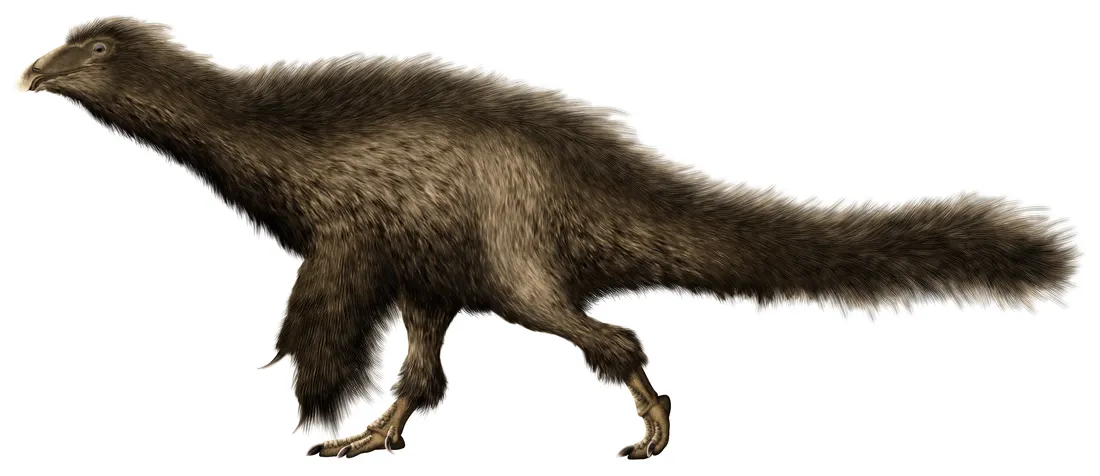
Illustration of Beipiaosaurus, a shaggy brown dinosaur with long fuzzy feathers and a bushy tail

2. Beipiaosaurus

Say it: BAY-pyow-SORE-us Β· Means: β€œBeipiao lizard (a city in China)”

Size
About 7 ft (2.2 m) long
When
About 125 million years ago
Where
Asia (China)

πŸͺΆ Feathers: Fuzzy coat plus long, stiff quills

⭐ A shaggy dinosaur with big claws that mostly ate plants. Long, stiff quill-like feathers poked out of its fluffy coat.

Surprise! Feathered Plant-Eaters

For a long time, scientists thought only meat-eaters had feathers. Then they found fuzz and bristles on plant-eaters too.

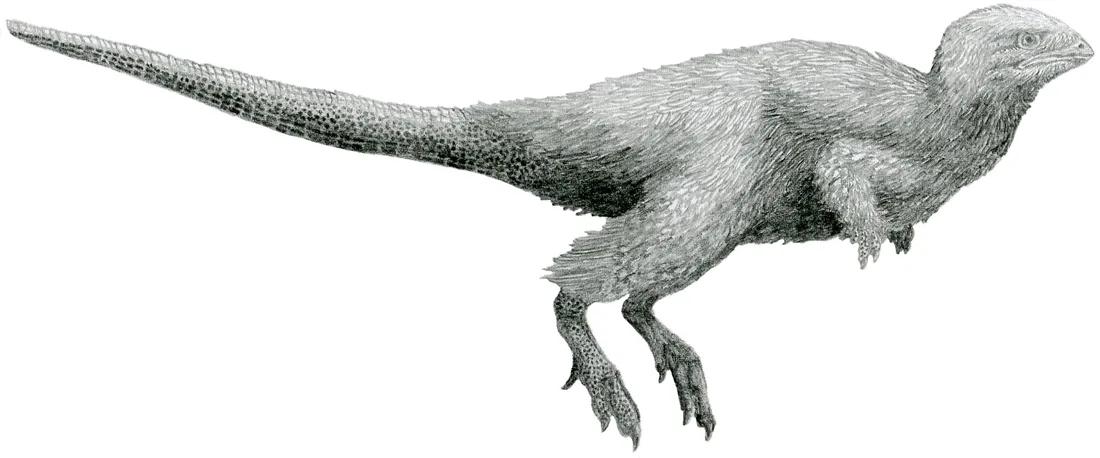
Illustration of Kulindadromeus, a small plant-eating dinosaur with a fuzzy white body and a scaly tail

3. Kulindadromeus

Say it: koo-LIN-dah-DROH-mee-us Β· Means: β€œKulinda runner (a place in Russia)”

Size
About 5 ft (1.5 m) long
When
About 160 million years ago
Where
Asia (Siberia, Russia)

πŸͺΆ Feathers: Fuzz on its body, scales on its tail

⭐ A small plant-eater with fuzz on its body and scales on its tail. It made scientists wonder if lots of dinosaurs had some feathers.

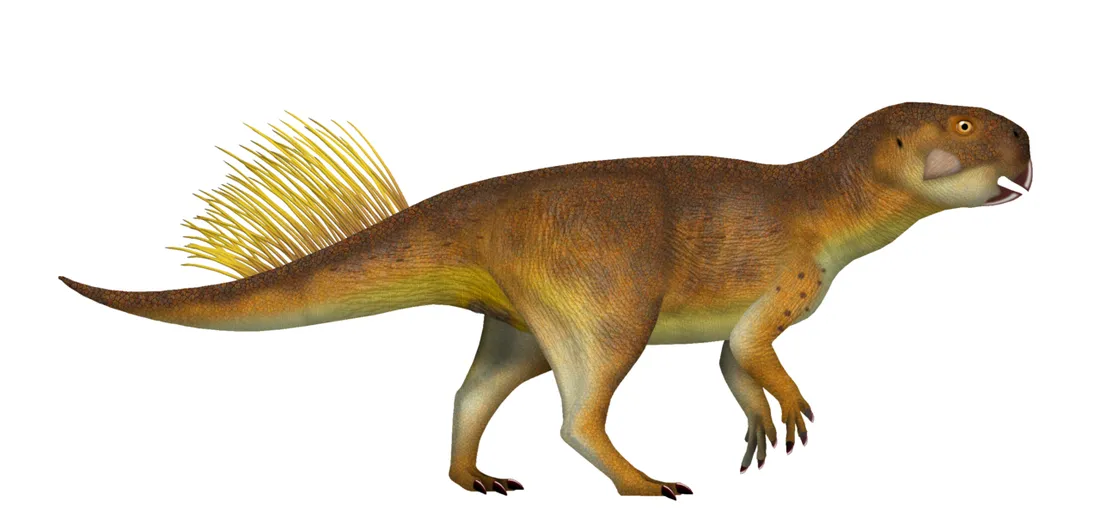
Illustration of Psittacosaurus, a parrot-beaked dinosaur with a row of long bristles on its tail

4. Psittacosaurus

Say it: SIT-ah-koh-SORE-us Β· Means: β€œParrot lizard”

Size
About 6.5 ft (2 m) long
When
About 125 million years ago
Where
Asia (China and Mongolia)

πŸͺΆ Feathers: Long bristles on top of its tail

⭐ It had a beak like a parrot and a row of long bristles on its tail, like a brush. Those bristles may have been an early kind of feather.

Fancy Show-Offs

Some dinosaurs had colorful or extra-long feathers just for showing off, like peacocks do today.

Illustration of Caihong with shiny black feathers and a rainbow-colored green and purple neck

5. Caihong

Say it: CHY-hong Β· Means: β€œRainbow with a big crest”

Size
About 16 in (40 cm) long, like a duck
When
About 160 million years ago
Where
Asia (China)

πŸͺΆ Feathers: Shiny rainbow neck feathers

⭐ Its neck feathers shimmered with rainbow colors, like a hummingbird's or a pigeon's neck. It also had a little bony crest on its head.

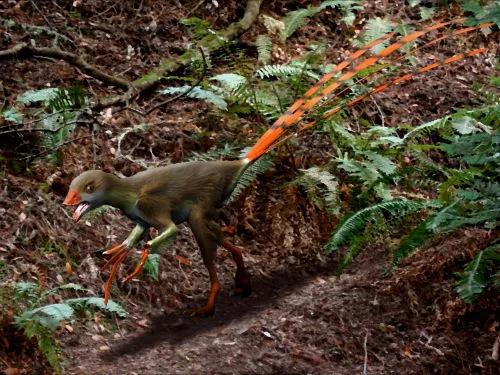
Illustration of Epidexipteryx in a forest with four long orange ribbon feathers on its tail

6. Epidexipteryx

Say it: EP-ih-dex-IP-ter-ix Β· Means: β€œDisplay feather”

Size
About pigeon-sized
When
About 165 million years ago
Where
Asia (China)

πŸͺΆ Feathers: Four long ribbon tail feathers

⭐ This tiny dinosaur couldn't fly, but it had four long ribbon-like tail feathers. It probably waved them to show off, like a bird of paradise.

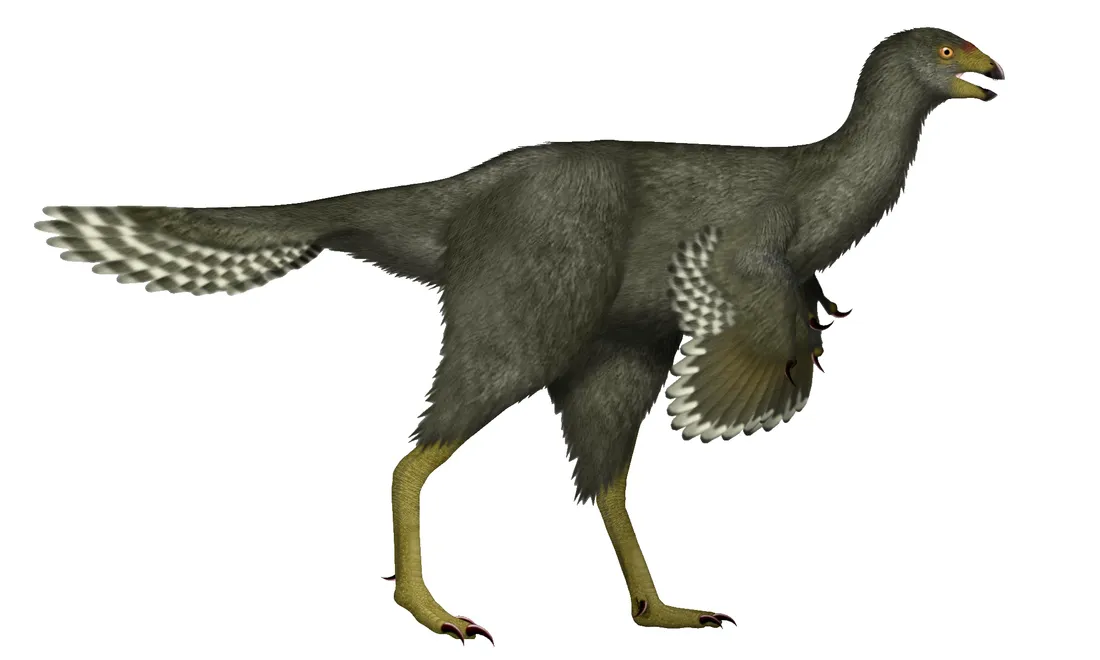
Illustration of Caudipteryx, a turkey-sized dinosaur with a fan of striped feathers on its tail and arms

7. Caudipteryx

Say it: caw-DIP-ter-ix Β· Means: β€œTail feather”

Size
About 3 ft (1 m) long, like a turkey
When
About 125 million years ago
Where
Asia (China)

πŸͺΆ Feathers: A fan of feathers on its tail and arms

⭐ It had a fan of feathers on its tail like a turkey. It also swallowed little stones to help grind up its food, just like chickens do today!

Feathered Raptors and Parents

Raptors like Velociraptor and their cousins had real wing feathers, even though most of them couldn't fly.

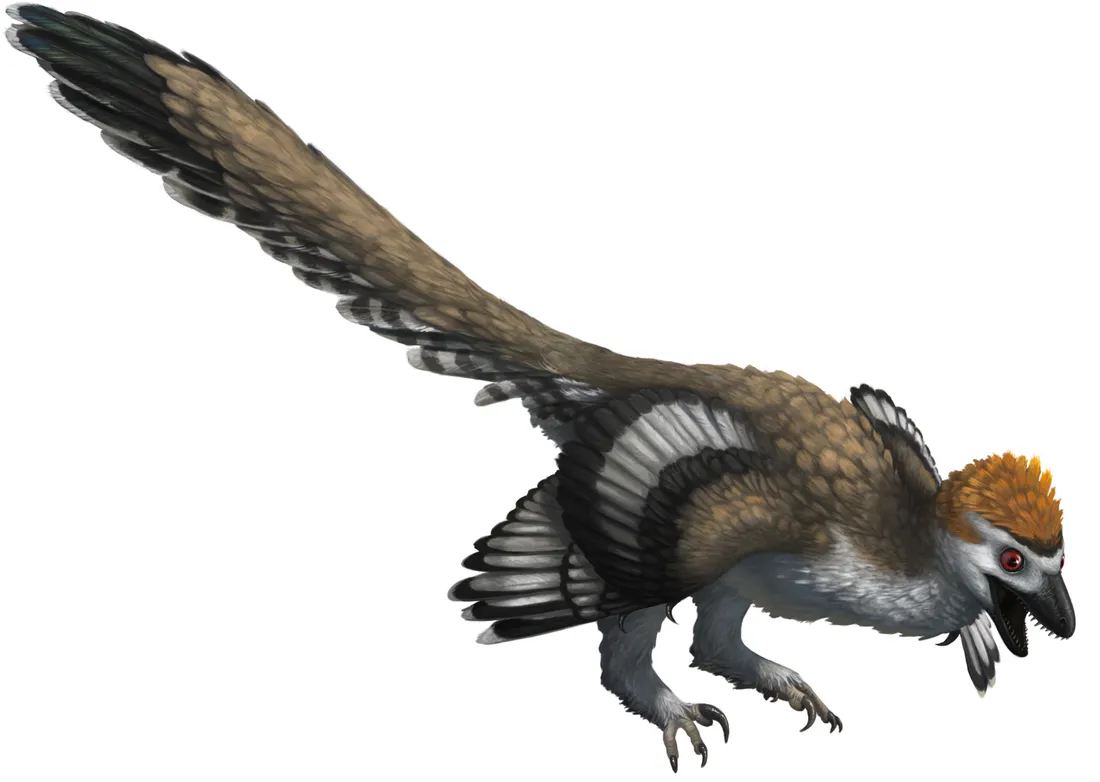
Illustration of Zhenyuanlong, a brown raptor with big feathered wings, an orange crest and a long feathered tail

8. Zhenyuanlong

Say it: jun-yoo-AHN-long Β· Means: β€œZhenyuan's dragon (named after a fossil collector)”

Size
About 6.5 ft (2 m) long
When
About 125 million years ago
Where
Asia (China)

πŸͺΆ Feathers: Big wing feathers, like a bird's

⭐ A close cousin of Velociraptor with big, bird-like wings. But its arms were short and its body was heavy, so it couldn't fly.

Illustration of Citipati, a tall feathered dinosaur with a beak, a long neck and a feathery tail

9. Citipati

Say it: CHIT-ee-PAH-tee Β· Means: β€œNamed after a dancing skeleton from Tibetan stories”

Size
About 9.5 ft (2.9 m) long
When
About 75 million years ago
Where
Asia (Mongolia)

πŸͺΆ Feathers: Probably feathered arms and tail

⭐ Fossils show Citipati sitting on its nest with its arms spread over its eggs, just like a mother hen! Feathered arms would have kept the eggs safe.

Strange Gliders

A few tiny dinosaurs tried out the air. Some had feathered wings, and one even had wings like a bat!

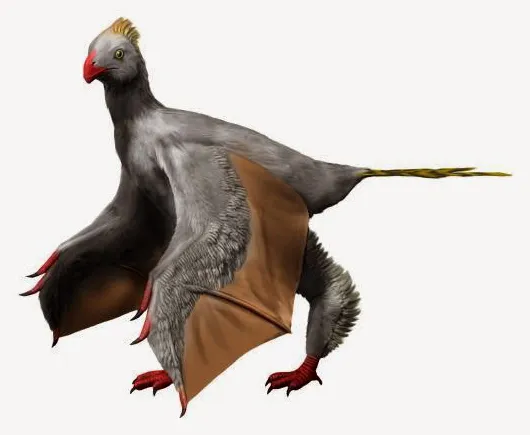
Illustration of Yi qi, a small fuzzy dinosaur with bat-like skin wings and a red face

10. Yi qi

Say it: ee-CHEE Β· Means: β€œStrange wing”

Size
About pigeon-sized
When
About 160 million years ago
Where
Asia (China)

πŸͺΆ Feathers: Fuzzy feathers plus bat-like skin wings

⭐ A fuzzy little dinosaur with wings made of skin, like a bat's. It probably glided from tree to tree. No other dinosaur like it was known until 2015!

More feathered flyers, like four-winged Microraptor and Archaeopteryx, are on our flying dinosaurs page.

Why Did Dinosaurs Have Feathers If They Couldn't Fly?

Staying warm

A fluffy coat works like a winter jacket. Yutyrannus lived in a chilly place where its feathers would have kept it cozy.

Showing off

Bright colors and long feathers helped dinosaurs attract a mate or say β€œstay away!”, like peacocks and parrots do.

Keeping eggs safe

Parents like Citipati sat on their nests and covered the eggs with feathered arms to keep them warm and shaded.

Running and climbing

Flapping feathered arms may have helped some dinosaurs balance, turn quickly, or scramble up steep slopes.

Learning to fly

Feathers came first and flying came later. Over millions of years, some small feathered dinosaurs became the first birds.

What Colors Were Feathered Dinosaurs?

Feathers hold tiny color packets called melanosomes (meh-LAN-oh-sohms). They're so small you need a super-strong microscope to see them, but some fossils still have them! Their shapes tell scientists what color the feathers were. Here's what they found:

Sinosauropteryx

Ginger with a striped tail, like a red panda, and a dark β€œbandit mask.”

Meet it β†’

Anchiornis

Black and white wings with a reddish-orange crest, like a woodpecker.

Meet it β†’

Microraptor

Shiny black with a blue-ish sheen, just like a crow or a starling.

Meet it β†’

Caihong

Black body with a shimmering rainbow neck, like a hummingbird.

Meet it β†’

Psittacosaurus

Dark on top and pale underneath, to help it hide in shady forests.

Meet it β†’

How Big Were Feathered Dinosaurs?

Feathered dinosaurs came in every size. Here's how long they were from nose to tail, compared with a chicken and a school bus. Sizes are scientists' best estimates.

πŸ” Chicken
1.3 ft
Caihong
1.3 ft
Caudipteryx
3 ft
Kulindadromeus
5 ft
Zhenyuanlong
6.5 ft
Psittacosaurus
6.5 ft
Beipiaosaurus
7 ft
Citipati
9.5 ft
Yutyrannus
30 ft
🚌 School bus
40 ft

How Do We Know Dinosaurs Had Feathers?

Feathers pressed in stone

In northeast China, fine volcanic ash and lake mud buried animals so gently that the outlines of their feathers were saved. The first one, Sinosauropteryx, was found in 1996.

Quill knobs on bones

Big feathers leave little bumps where they attach to the arm bone. Velociraptor's arm has them, so we know it had wing feathers even without a feather fossil.

Trapped in amber

In 2016, scientists found a tiny feathered dinosaur tail trapped in amber, which is hardened tree sap. You can see every fluffy feather in 3D!

🐦 Feathers are one big clue that birds are dinosaurs. Find out why birds are living dinosaurs and how a chicken is related to T. rex.

Activity: Fuzz or Feather?

Next time you find a feather on a walk, or hold a feather duster, take a close look together:

  • Does it have a stiff middle stick with flat sides? That's a vaned feather, like Caudipteryx's tail.
  • Is it soft and fluffy all over? That's down, a lot like the fuzz on Yutyrannus.
  • Is one side wider than the other? That's a flight feather, the kind Microraptor used to glide.

Then draw your own feathered dinosaur and pick its colors. Will it be a rainbow show-off or a fluffy fuzzball?

Frequently Asked Questions

What dinosaurs had feathers?

Lots of them! Velociraptor, Microraptor, Archaeopteryx, Sinosauropteryx, Caudipteryx, Citipati and the giant tyrannosaur Yutyrannus all had feathers. Most were meat-eating theropods, the dinosaur group that birds came from, but some plant-eaters like Kulindadromeus and Psittacosaurus had fuzz or bristles too.

Did T. rex have feathers?

Probably not much, at least as a grown-up. Patches of fossil T. rex skin show small, bumpy scales. Its smaller cousin Yutyrannus was covered in fuzzy feathers, though, so some scientists think baby T. rex may have been a little fluffy. Nobody knows for sure yet!

Did Velociraptor have feathers?

Yes. A Velociraptor arm bone has little bumps called quill knobs, where big wing feathers attached, just like on a bird's wing. Real Velociraptors were feathered and about the size of a turkey, much smaller than the scaly ones in movies.

What was the biggest feathered dinosaur?

Yutyrannus, a cousin of T. rex from China, is the biggest dinosaur found with feather fossils. It was about 30 feet (9 meters) long and weighed about as much as a car.

Could feathered dinosaurs fly?

Most couldn't. They used their feathers for warmth, showing off and keeping eggs safe. A few small ones, like Microraptor, could glide or fly, and the feathered dinosaurs that learned to fly well became birds.

Did all dinosaurs have feathers?

No. Many big dinosaurs, like Triceratops, Edmontosaurus and long-necked sauropods, had scaly skin. But feathers or fuzz turned up in so many kinds of dinosaurs that scientists are still finding out just how common they were.

Why don't dinosaurs in movies have feathers?

Many famous dinosaur movies were made before most feathered dinosaur fossils were found, so filmmakers drew them scaly like lizards. Scientists found the first feathered dinosaur that wasn't a bird in China in 1996, and hundreds more have turned up since.

Keep exploring: see why birds are dinosaurs, find out if chickens are dinosaurs, meet the flying dinosaurs, or see all the types of dinosaurs.

Image credits (via Wikimedia Commons): Caihong by Lucas-Attwell (CC BY-SA 4.0); Yutyrannus and Psittacosaurus by TotalDino (CC BY 4.0); Caudipteryx by TotalDino (CC BY-SA 4.0); Beipiaosaurus and Citipati by PaleoNeolitic (CC BY 4.0); Kulindadromeus by Tom Parker (CC BY-SA 4.0); Epidexipteryx by Nobu Tamura (CC BY-SA 3.0); Yi qi by Nobu Tamura (CC BY-SA 4.0); Zhenyuanlong by Emily Willoughby (CC BY-SA 4.0). Images resized.

Does your little one love dinosaurs? πŸ¦•

Explore our dinosaur-themed nursery rhymes and kids' songs!