
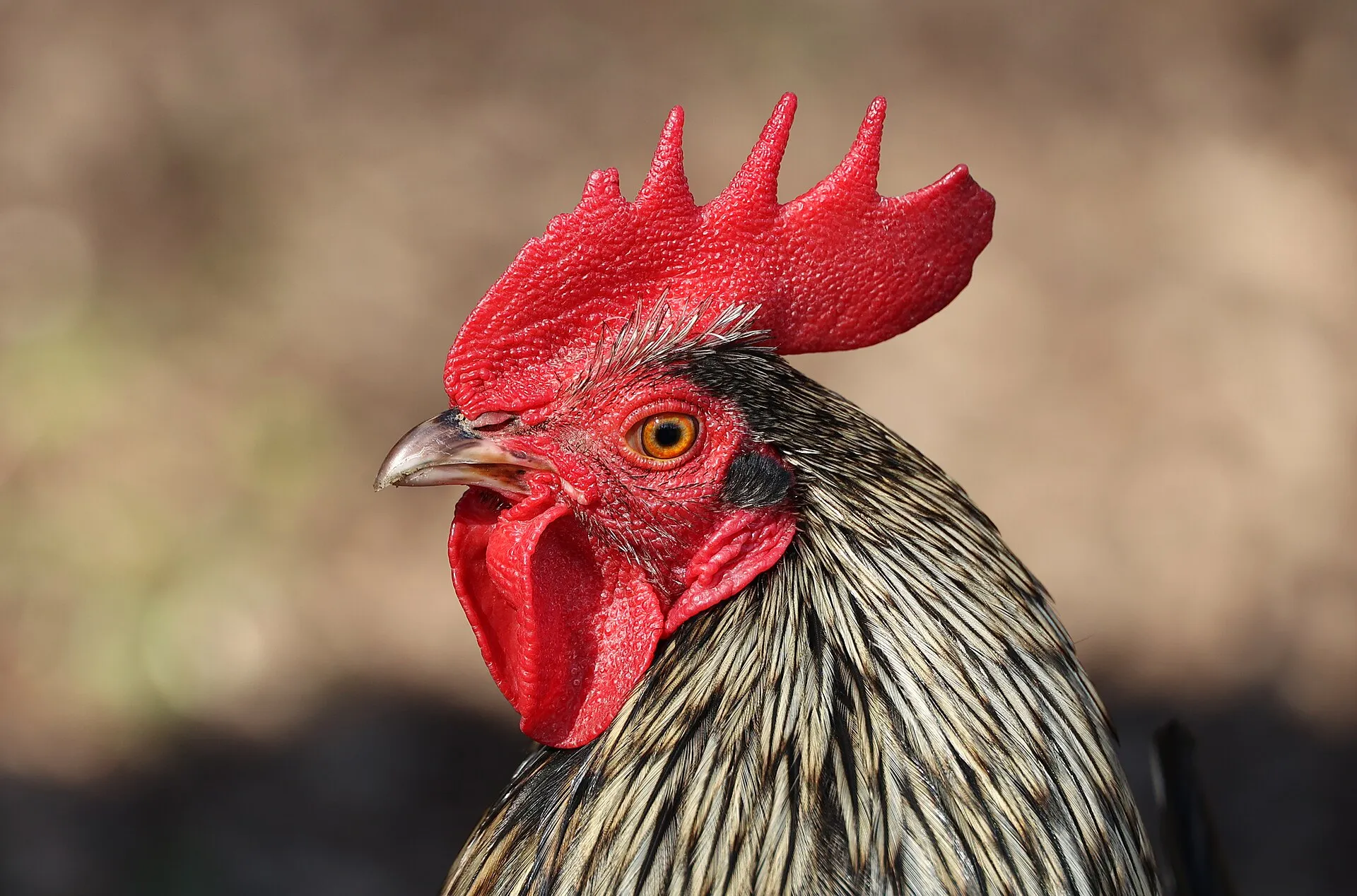
Are Chickens Dinosaurs?
Yes! The chicken in the farmyard is a real, living dinosaur and a distant cousin of T. rex. Find out how scientists know, and what happened when they tried to bring out the dinosaur hiding inside a chicken.
Quick Answer
Yes, chickens are dinosaurs! Chickens are birds, and birds are the one group of dinosaurs that survived the asteroid 66 million years ago. That makes a chicken a theropod, the same two-legged dinosaur group as T. rex. Chickens didn't come from T. rex, though. They are distant cousins.
Why Is a Chicken a Dinosaur?
It works like a family tree. Every chicken is a bird. Every bird is a dinosaur. So every chicken is a dinosaur too, the same way a puppy is a dog and a dog is a mammal.
Scientists figured out that birds are dinosaurs by finding hundreds of fossils of feathered dinosaurs. You can see those clues, and meet the feathered dinosaurs in between, in our guide Are Birds Dinosaurs? This page is all about the chicken, which has turned out to be one of scientists' favorite dinosaurs to study.
The T. rex Protein That Matched a Chicken
In 2005, scientist Mary Schweitzer found something amazing inside a 68-million-year-old T. rex leg bone: soft, stretchy bits that looked like they had once been living tissue.
In 2007, her team and scientist John Asara pulled out tiny pieces of a protein called collagen. Collagen is what holds bones, skin and muscles together, and its pattern is a bit different in every kind of animal. When they compared the T. rex pieces with the animals on file, the closest match was the chicken. Headlines said “T. rex was a big chicken!”
🔍 The fine print
Chicken won partly because it was one of very few animals whose collagen was on file back then. In 2008 the team compared more animals, and T. rex grouped with birds in general (chickens and ostriches) more closely than with alligators or anything else. So the chicken isn't T. rex's special best friend. Every bird is an equally close cousin!
Chicken vs. T. rex: Spot the Dinosaur
Put a chicken next to a T. rex and look past the size. They have a lot more in common than you'd think!
| Feature | 🐔 Chicken | 🦖 T. rex |
|---|---|---|
| Walks on two legs | ✅ Yes | ✅ Yes |
| Three big forward toes | ✅ Yes | ✅ Yes |
| Scaly feet and legs | ✅ Yes | ✅ Yes |
| Wishbone | ✅ Yes | ✅ Yes |
| Air-filled bones | ✅ Yes | ✅ Yes |
| Lays hard-shelled eggs | ✅ Yes | ✅ Yes |
| Feathers | ✅ All over | 🤔 Maybe a few |
| Teeth | ❌ No, a beak | ✅ About 60 |
| Long bony tail | ❌ Short stub | ✅ Very long |
| Size | About 2 kg | About 8,000 kg |
Fun fact: scientists who study how T. rex moved often test their ideas on chickens, because a chicken's legs work the same way.
Meet the “Wonderchicken” That Lived With the Last Dinosaurs
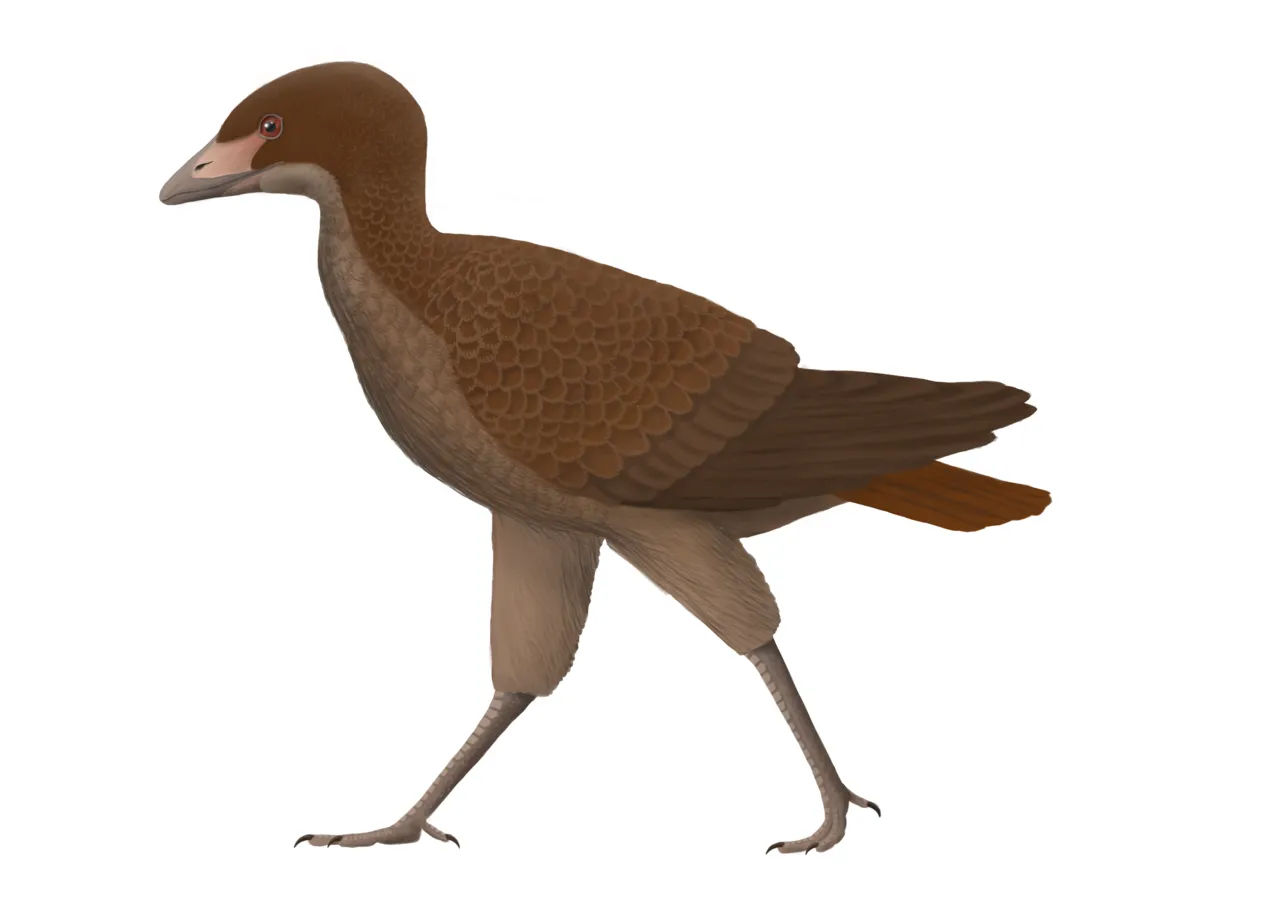
In 2020, scientists scanned a rock from a quarry in Belgium and found a perfect little bird skull hiding inside. They named it Asteriornis (say it: ass-TEER-ee-OR-niss), but everyone calls it the Wonderchicken.
It lived about 66.7 million years ago, less than a million years before the asteroid hit. It was about the size of a small duck and had a face that mixed chicken and duck features. Scientists think it was close to the shared ancestor of chickens and ducks, the kind of small, ground-dwelling bird that made it through the disaster.
Can Scientists Turn a Chicken Into a Dinosaur?
Some scientists have tried to wake up the “dinosaur” that's still written in a chicken's genes. Here's what really happened in the lab:
Chickens with dinosaur snouts
Scientists at Yale and Harvard switched off two growth signals in chicken embryos. The chicks grew snout-like skull bones similar to Velociraptor and Archaeopteryx instead of a normal beak skeleton. The eggs were never hatched. The goal was to learn how beaks evolved, not to make a monster.
Hidden dinosaur teeth
Birds lost their teeth more than 60 million years ago, but chickens still carry some of the old tooth-making instructions in their DNA. In chicken embryos with a rare gene change, scientists saw tiny cone-shaped teeth start to grow, a lot like a crocodile's.
Walking with a fake tail
Researchers in Chile gave young chickens a stick-on tail, a bit like a little plunger. With the extra weight behind them, the chickens stood and walked more like the big meat-eating dinosaurs did. It helped scientists figure out how T. rex moved.
The “chickenosaurus” dream
Famous fossil hunter Jack Horner wrote a book about how a chicken could be turned back into something dinosaur-like. Adding a long tail turned out to be the hardest part. Nobody has made a real chickenosaurus, and many scientists think it's better to just study chickens to learn about dinosaurs.
Note for parents: none of these experiments produced a living “dino-chicken.” The embryo studies were stopped before hatching, and the scientists involved say their goal is to understand evolution.
Where Did Chickens Come From?
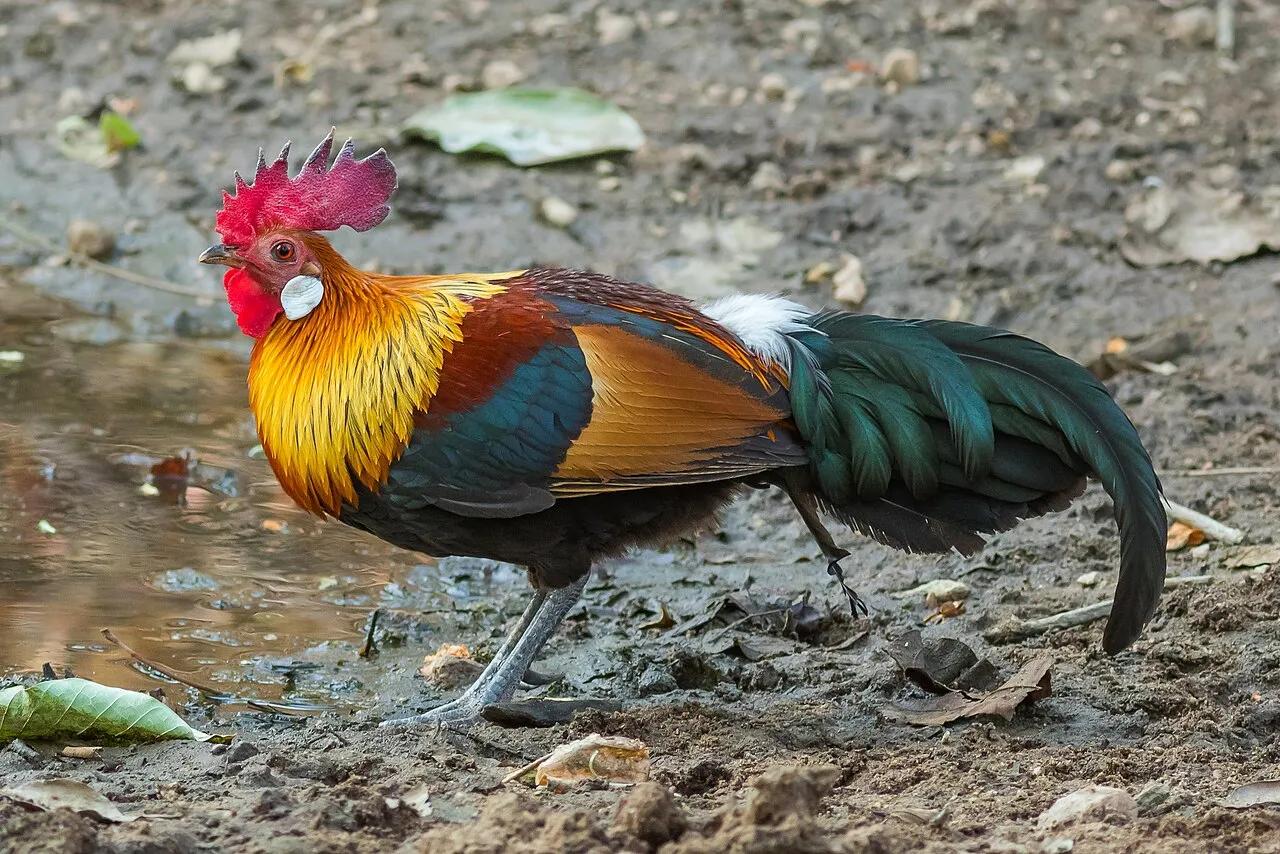
Every farm chicken in the world comes from a wild bird called the red junglefowl, which still lives in the forests of South and Southeast Asia today.
About 3,500 years ago, in what is now Thailand, red junglefowl started hanging around rice and millet fields to snack on the grain. Little by little they got used to people and became the first chickens. (Thailand is a great place for dinosaurs, too. Meet the giant new dinosaur found there!)
So the full chicken story goes: small feathered dinosaurs → early birds → the Wonderchicken's family → red junglefowl → the chicken in your backyard.
Activity: Find the Dinosaur in Your Dinner
Next time you have roast chicken, save the bones and turn your kitchen into a dinosaur lab!
- Grown-up step: simmer the bones in water for an hour, then scrub them clean with an old toothbrush and let them dry.
- Find the wishbone. T. rex and Velociraptor had one too!
- Look at a leg bone. Is it heavy or light? Bird bones are light because, like a T. rex's, many are filled with air spaces.
- Lay the bones out on paper and try to build half a chicken skeleton, like a paleontologist putting a fossil together.
Tip for parents: wash hands after handling raw chicken, and keep small bones away from toddlers.
Frequently Asked Questions
Is a chicken really a dinosaur?
Yes! Chickens are birds, and all birds are dinosaurs. Scientists put chickens in the same big group as T. rex and Velociraptor: the theropods, the two-legged dinosaurs. Chickens are “avian dinosaurs,” the kind that survived.
Did chickens come from T. rex?
No. A chicken is not T. rex's great-great-grandchild. Chickens and T. rex are distant cousins that share an older ancestor. Birds came from small, feathered theropods, a different branch of the family from T. rex.
Is the chicken the closest living relative of T. rex?
Sort of! All birds are T. rex's closest living relatives, and the chicken is no closer than a pigeon or an ostrich. The chicken became famous in 2007 because its protein was the closest match to T. rex protein that scientists had on file at the time.
Did chickens live with T. rex?
Not modern chickens. But the “Wonderchicken,” a small bird related to the ancestors of chickens and ducks, lived about 66.7 million years ago, right at the end of the time of T. rex.
Can scientists turn a chicken into a dinosaur?
Not really. Scientists have grown chicken embryos with snout-like faces and seen tooth buds start to form, but those embryos were never hatched. A chicken already is a dinosaur, so the experiments are about learning how birds changed, not bringing back T. rex.
Which came first, the chicken or the egg?
The egg, by a lot! Dinosaurs were laying eggs more than 190 million years ago, long before the first chicken hatched about 3,500 years ago.
Image credits (via Wikimedia Commons): Rooster by Clément Bardot (CC BY-SA 4.0); Red junglefowl by Rudraksha Chodankar (CC BY-SA 4.0); Asteriornis life restoration by BipedalSarcopterygian201.3 (CC BY-SA 4.0).
Does your little one love dinosaurs? 🦕
Explore our dinosaur-themed nursery rhymes and kids' songs!