
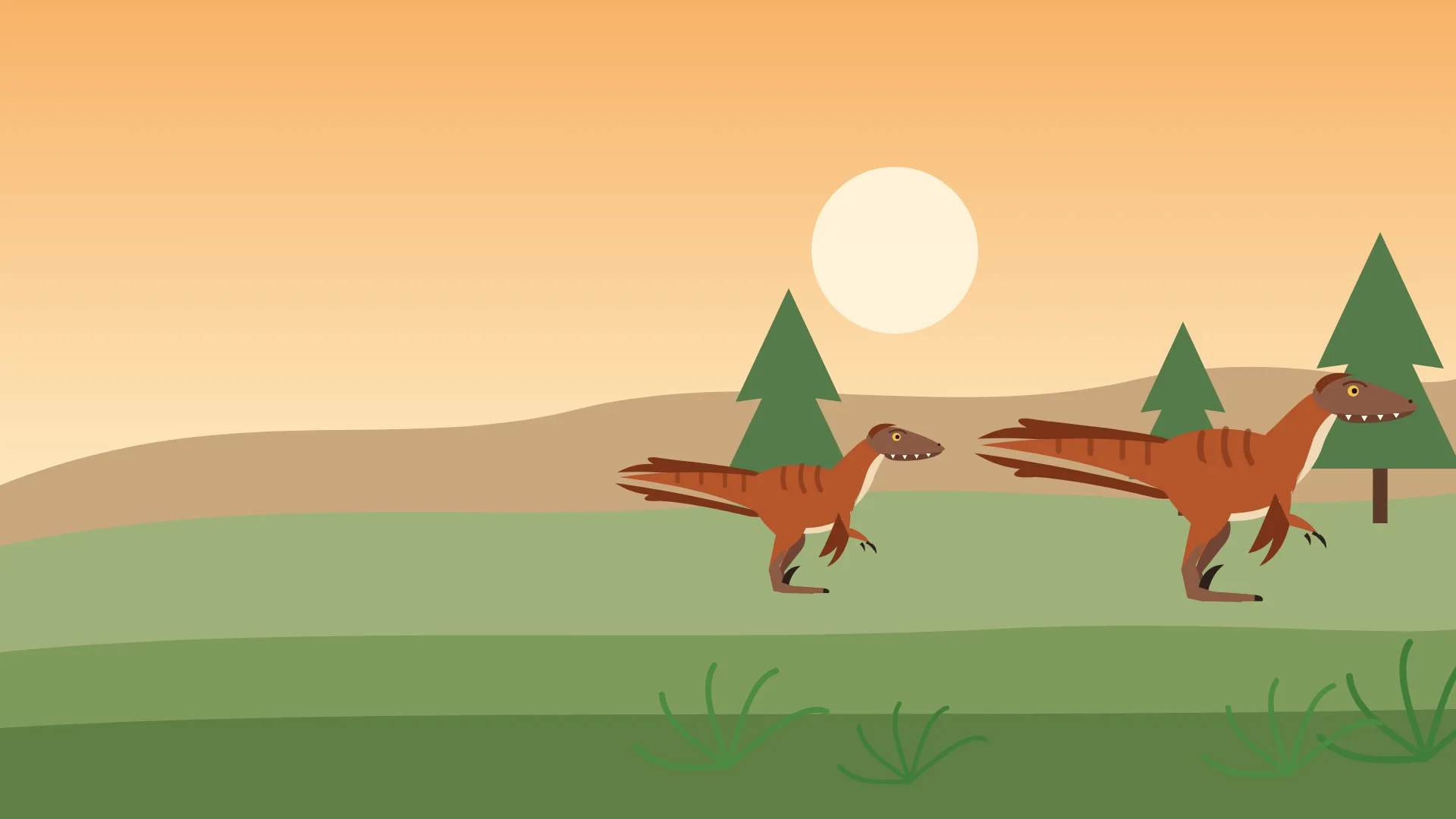
Deinonychus
Meet the feathered raptor with a "terrible claw"! Find out how big Deinonychus was, what its giant toe claw was for, and how it became the real star behind the raptors in Jurassic Park.
What was Deinonychus?
Deinonychus was a feathered, meat-eating raptor with a big curved "terrible claw" on each foot. It lived in North America about 115 to 108 million years ago, grew about 11 feet (3.4 m) long, and was the real model for the raptors in Jurassic Park.
Meet Deinonychus
Deinonychus (say die-NON-ih-kus) was a raptor, a fast, clever, meat-eating dinosaur that walked on two legs. Its name means "terrible claw". That's because the second toe on each foot had a huge, curved claw shaped like a sickle, a hooked farm blade.
Fossil hunter Barnum Brown found the first bones in Montana in 1931, but he never gave the dinosaur a proper name. In 1964, scientist John Ostrom and his team dug up many more bones nearby, and Ostrom named Deinonychus in 1969.
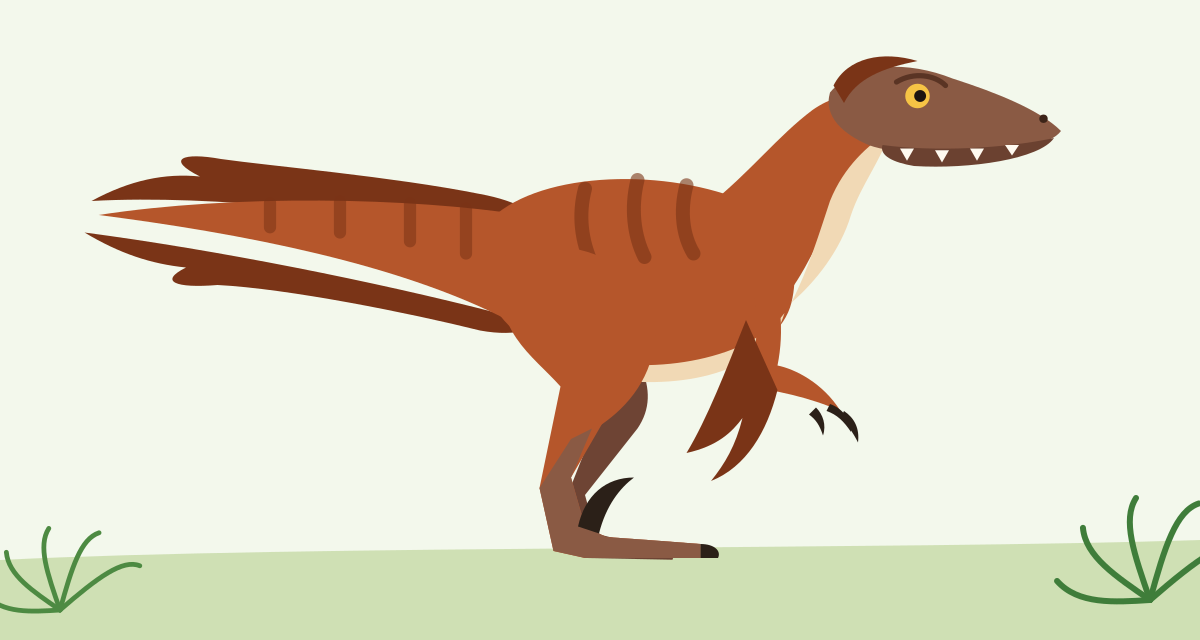
Deinonychus had a long, stiff tail for balance, long arms with three clawed fingers, sharp, curved teeth, and a big brain for a dinosaur. It was a lot more like a bird than a lizard.
Deinonychus Quick Facts
| Pronounced | die-NON-ih-kus |
|---|---|
| Name means | Terrible claw |
| Type | Raptor (dromaeosaur), a feathered theropod |
| Diet | Carnivore (meat) |
| Length | About 11 ft (3.4 m) |
| Height | About 3 ft (0.9 m) at the hips |
| Weight | About 150–220 lb (70–100 kg), estimate |
| Big claw | About 5 in (13 cm) long, with its horny cover |
| When | About 115–108 million years ago, Early Cretaceous |
| Where | USA: Montana, Wyoming and Oklahoma |
| Named by | John Ostrom, 1969 |
Fun Facts About Deinonychus
How Big Was Deinonychus?
A grown-up Deinonychus was about 11 feet (3.4 metres) long from the tip of its nose to the end of its tail. That's about as long as a small car! Its hips were about 3 feet (0.9 m) off the ground, around the height of a kitchen table.
Scientists think it weighed about 150 to 220 pounds (70 to 100 kg), about the same as a grown-up person. Much of its length was its long, skinny tail, so it was lighter than it looks.
Deinonychus was a middle-sized raptor. It was much bigger than turkey-sized Velociraptor, but smaller than giant Utahraptor.
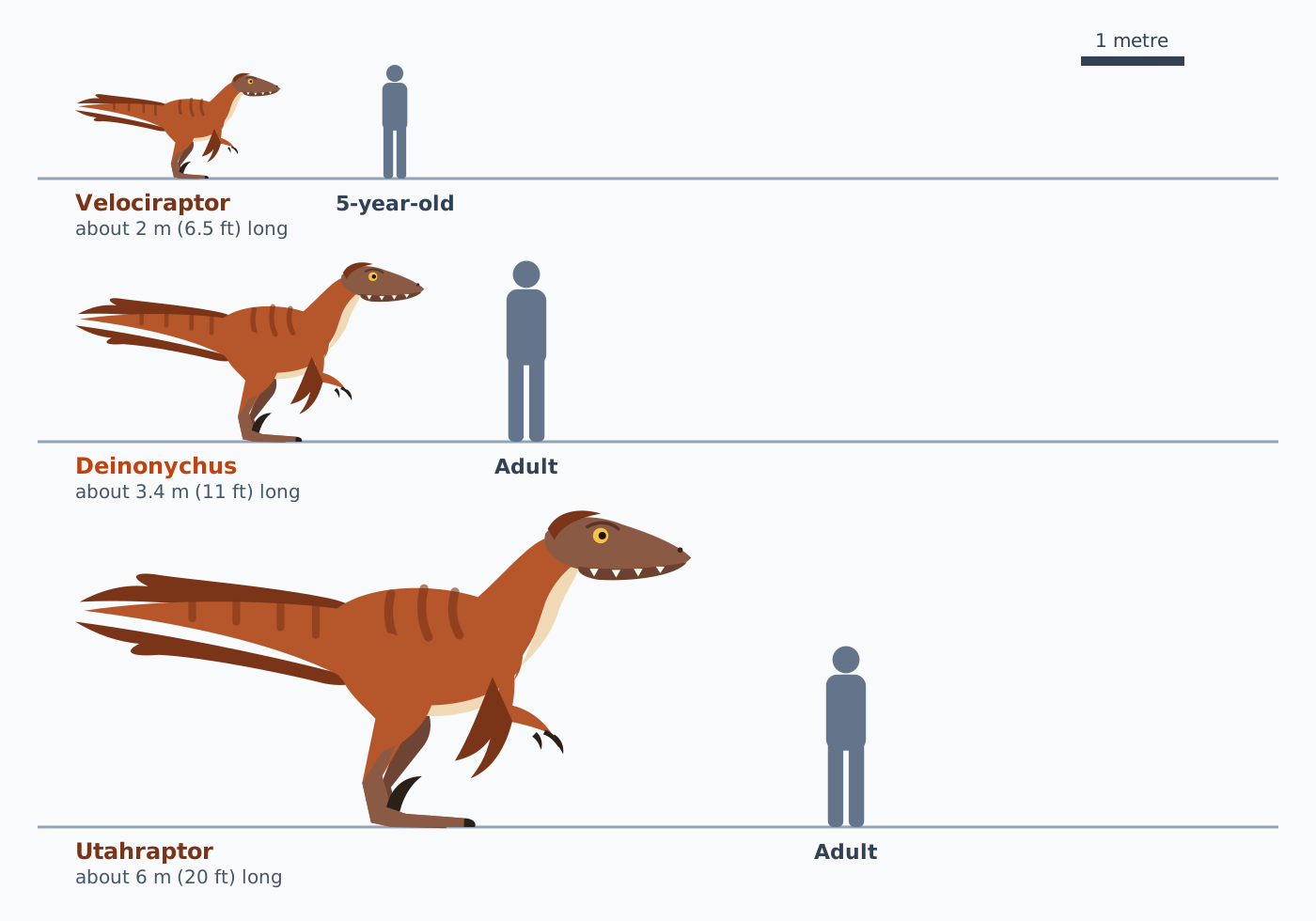
📏 Try this: Lie down on the floor with two grown-ups in a line, head to toe. That's roughly how long a Deinonychus was!
The Terrible Claw: What Was It For?
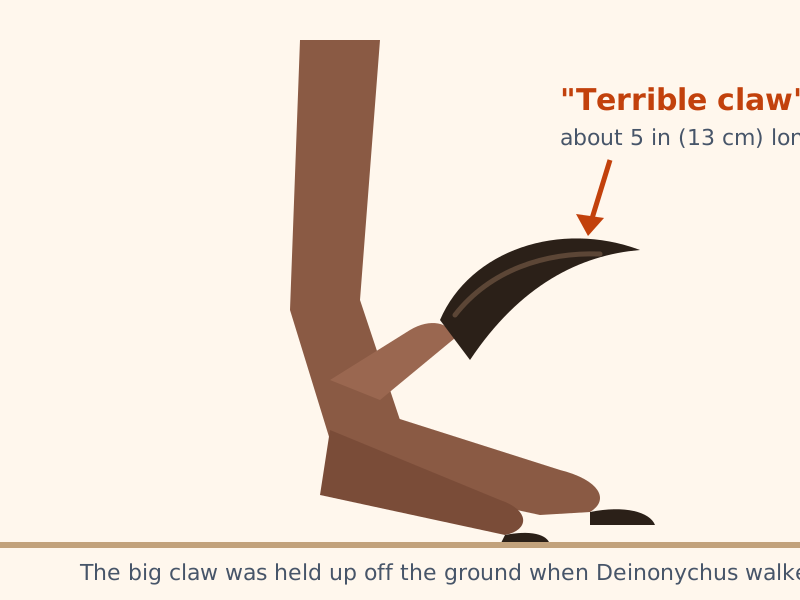
The big claw on Deinonychus's second toe was about 5 inches (13 cm) long when it still had its horny cover, like a fingernail. That's about as long as a grown-up's finger!
Deinonychus held this claw up off the ground when it walked, so it stayed sharp. It walked on just two toes on each foot.
People used to think raptors used the claw to slash at prey. Today, many scientists think it worked more like the talons of a hawk or eagle: Deinonychus may have jumped on smaller animals and used the claws to grip and pin them down, flapping its feathered arms to keep its balance.
Did Deinonychus Have Feathers?
Almost certainly, yes! No feathers or skin have ever been found with a Deinonychus fossil. But its close cousins did have feathers. Microraptor fossils show feathers clearly, and a Velociraptor arm bone has little bumps called quill knobs, where big wing feathers were attached.
Because the whole raptor family had feathers, scientists draw Deinonychus covered in feathers too, with wing-like feathers on its arms and a feathery fan on its tail. It couldn't fly, though. A grown-up was far too heavy.
🪶 Meet more fluffy and fancy dinosaurs, from giant Yutyrannus to rainbow-colored Caihong, on our Feathered Dinosaurs page.
What Did Deinonychus Eat? Did It Hunt in Packs?
Deinonychus was a carnivore, so it ate meat. It had rows of sharp, curved teeth with jagged edges, like little steak knives.
Its teeth are often found next to the bones of Tenontosaurus (say teh-NON-toe-SORE-us), a big plant eater with a very long tail. A grown-up Tenontosaurus weighed 1 to 4 tonnes, way too big for one Deinonychus to take down alone.
In Montana, scientists found four grown-up and one young Deinonychus together with a Tenontosaurus. That made John Ostrom wonder if they hunted in packs, like wolves. Other scientists aren't so sure. They think Deinonychus might have crowded around a meal and squabbled over it, more like Komodo dragons do. Scientists are still working on the answer!
Meet more meat-eating dinosaurs on our Types of Dinosaurs page.
Deinonychus Eggs Were Probably Blue!
One Deinonychus skeleton was found with pieces of eggshell right under its belly. It looks like this Deinonychus was sitting on its eggs to keep them warm, just like a bird on its nest.
In 2018, scientists studied tiny bits of color left in the eggshell. They found that Deinonychus eggs were probably blue-green, like a robin's eggs! Colored eggs are usually laid in open nests, where they can hide among leaves and shadows.
Learn about other dinosaur eggs and nests on our Dinosaur Eggs page.

Deinonychus vs Velociraptor: The Real Jurassic Park Raptor
Remember the tall, clever raptors in Jurassic Park? The movie called them Velociraptors, but they were really based on Deinonychus. Author Michael Crichton said his raptors matched Deinonychus in almost every detail. He just thought the name "Velociraptor" sounded more dramatic.
Real Velociraptors were only about the size of a turkey. The movie raptors were even a bit bigger than Deinonychus, closer in size to Utahraptor. And unlike the movie ones, real raptors had feathers.
Velociraptor
- Length
- About 6.5 ft (2 m)
- Weight
- About 30 lb (15 kg)
- When
- 75–71 million years ago
- Where
- Mongolia and China
Deinonychus
- Length
- About 11 ft (3.4 m)
- Weight
- About 150–220 lb (70–100 kg)
- When
- 115–108 million years ago
- Where
- Western and central USA
Utahraptor
- Length
- About 20 ft (6 m)
- Weight
- About 1,000 lb (500 kg)
- When
- About 135 million years ago
- Where
- Utah, USA
| Raptor | Length | Weight | When | Where |
|---|---|---|---|---|
| Velociraptor | About 6.5 ft (2 m) | About 30 lb (15 kg) | 75–71 million years ago | Mongolia and China |
| Deinonychus | About 11 ft (3.4 m) | About 150–220 lb (70–100 kg) | 115–108 million years ago | Western and central USA |
| Utahraptor | About 20 ft (6 m) | About 1,000 lb (500 kg) | About 135 million years ago | Utah, USA |
Weights are scientists' estimates.
The Dinosaur That Changed How We See Dinosaurs
Before Deinonychus, many people pictured dinosaurs as slow, cold-blooded, tail-dragging lizards. When John Ostrom studied Deinonychus, he saw an animal built to be active and agile, with a stiff tail held up off the ground and a body a lot like a bird's.
His work started what is called the "Dinosaur Renaissance", a big change in how scientists thought about dinosaurs. It also helped prove an amazing idea: birds are living dinosaurs!
🐔 Find out why a chicken is a dinosaur cousin on our Are Birds Dinosaurs? page.
Where and When Did Deinonychus Live?
Deinonychus lived in the Early Cretaceous, about 115 to 108 million years ago. Its fossils come from rocks in Montana, Wyoming and Oklahoma. Back then, this land had rivers, swamps and forests of conifers and ferns.
It shared its home with plant eaters like Tenontosaurus, the armored Sauropelta, and in Oklahoma the giant long neck Sauroposeidon. A much bigger meat eater, Acrocanthosaurus, lived in Oklahoma too, so Deinonychus had to watch out!
Meet another North American dinosaur, a long neck that lived about 40 million years earlier, on our Camarasaurus page.
United States
Montana, Wyoming and Oklahoma (and maybe Maryland)
Deinonychus Activities for Kids
- Raptor walk: walk around the room on tiptoe, keeping one finger on each hand pointed up like a raised sickle claw. Can you stay balanced? Try holding your arms out like feathered wings.
- Measure the claw: cut a strip of paper 5 inches (13 cm) long and curve it into a hook. Compare it with your hand.
- Blue egg hunt: paint some hard-boiled eggs blue-green and hide them for a Deinonychus nest hunt.
- Color a raptor: print a free page from our Dinosaur Coloring Pages and give it feathers. Nobody knows Deinonychus's real colors, so you can choose!
Frequently Asked Questions
What kind of dinosaur is Deinonychus?
Deinonychus was a raptor, or dromaeosaur (say DROH-mee-oh-sore). Raptors were feathered, meat-eating dinosaurs that ran on two legs and had a big curved claw on each foot. Velociraptor was a smaller cousin.
How do you say Deinonychus?
Say it die-NON-ih-kus. The name means "terrible claw", after the big sickle-shaped claw on the second toe of each foot.
How big was Deinonychus?
Deinonychus was about 11 feet (3.4 metres) long from nose to tail, about as long as a small car. Its hips were about 3 feet (0.9 m) off the ground, and it probably weighed around 150 to 220 pounds (70 to 100 kg), about as much as a grown-up person.
When did Deinonychus live?
Deinonychus lived in the Early Cretaceous period, about 115 to 108 million years ago. That was more than 40 million years before T. rex.
Was Deinonychus the raptor in Jurassic Park?
Sort of! The "Velociraptors" in Jurassic Park were really based on Deinonychus. The author Michael Crichton used Deinonychus as his model but picked the name Velociraptor because it sounded more dramatic. Real Velociraptors were much smaller, about the size of a turkey.
Did Deinonychus have feathers?
Almost certainly yes. No Deinonychus feathers have been found, but its close cousins, like Velociraptor and Microraptor, had feathers. So scientists draw Deinonychus with feathers too, including wing-like feathers on its arms.
What did Deinonychus eat?
Deinonychus was a carnivore, so it ate meat. Its teeth are often found with the bones of Tenontosaurus, a big plant-eating dinosaur, so it probably hunted or fed on Tenontosaurus. It likely ate smaller animals too.
Did Deinonychus hunt in packs?
Scientists aren't sure. Several Deinonychus have been found together with a Tenontosaurus, which made people think they hunted in packs like wolves. Other scientists think they may have gathered at a meal more like Komodo dragons do. Footprints show that some raptors did walk in groups.
Where have Deinonychus fossils been found?
Deinonychus fossils come from Montana, Wyoming and Oklahoma in the United States. Teeth that might belong to Deinonychus have also been found in Maryland.
Sources: Natural History Museum (London) Dino Directory; Wikipedia's Deinonychus article and the studies it cites, including Ostrom (1969), Grellet-Tinner & Makovicky (2006) on the eggs, and Wiemann et al. (2018) on egg color. Sizes and weights are scientists' estimates.
Image credits: all Deinonychus artwork on this page is original artwork by Puffsaurus.
Does your little one love dinosaurs? 🦖
Explore our dinosaur-themed nursery rhymes and kids' songs!